
Blog
How to Find a Trustworthy Gun Appraiser and Spot a Lowball Estimate
An independent, USPAP-compliant firearms appraiser discloses any interest in your collection before valuing it; a gun shop's free quote is a buy offer, not a fair market value opinion. Here's how to tell the difference and vet a prospective appraiser before you hand over a collection.
If you've ever walked a firearm into a gun shop for a "free appraisal" and walked out with a number that felt low, you weren't imagining things. In most cases, you weren't appraised at all. You were quoted a buy offer, and those are built on a completely different set of math than a fair market value opinion. This guide breaks down what actually separates a trustworthy firearms appraiser from a shop counter estimate, and gives you concrete questions to ask before you trust anyone with a collection's valuation.
An Appraisal and an Offer to Buy Are Not the Same Thing
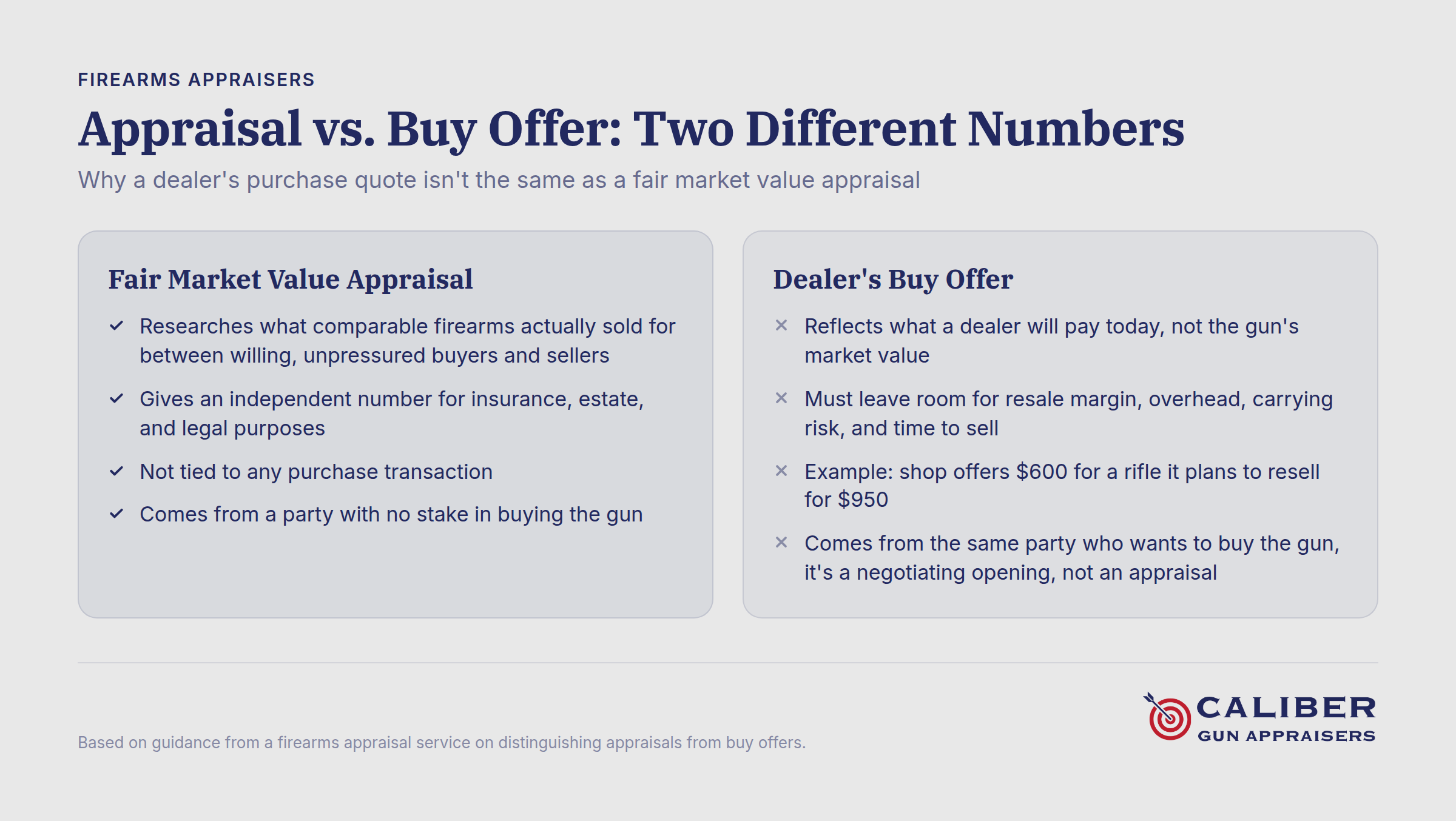
A fair market value appraisal researches what comparable firearms have actually sold for between willing, unpressured buyers and sellers. A buy offer is what a dealer is willing to pay today, and it has to leave room for the dealer's resale margin, overhead, carrying risk, and the time it takes to move inventory. Both are legitimate business functions. They are just not the same exercise, and a reader who compares the two numbers side by side is comparing apples to a wholesale price sheet.
A shop that quotes you $600 for a rifle it plans to resell for $950 isn't cheating you; it's pricing a purchase the way any reseller has to. The problem shows up when that buy offer gets presented, implicitly or explicitly, as an "appraisal" of what the gun is worth. It isn't one, and it was never meant to be.
Watch out: If the person giving you a value is the same person who wants to buy the gun from you, you are not looking at an independent appraisal. You're looking at a negotiating opening.
Our firearms appraisal service exists specifically to give collectors, heirs, and fiduciaries an independent number they can rely on for insurance, estate, and legal purposes, separate from any purchase transaction.
Why USPAP's Ethics Rule Matters for Firearms Owners
USPAP (the Uniform Standards of Professional Appraisal Practice) is the national standard that governs how a professional appraisal is developed and reported, and its Ethics Rule is the backbone of everything that makes an appraisal trustworthy. It requires an appraiser to perform an assignment with impartiality, objectivity, and independence, without advocating for either party, and to disclose any current or prospective interest in the property or in the people involved. USPAP is published and maintained by The Appraisal Foundation, and appraisers who hold credentials with recognized personal property organizations are expected to keep their USPAP knowledge current through periodic update courses, generally tied to each new two-year edition of the standard, as tracked by the American Society of Appraisers' continuing education requirements.
For personal property, including firearms, USPAP's Standards 7 and 8 govern the work itself. Standard 7 requires the appraiser to correctly identify the property, define the scope of work, and apply a defensible valuation methodology. Standard 8 requires a signed certification and full disclosure of any assumptions, limiting conditions, or interests that could affect the conclusion. An appraiser who can't explain how their report satisfies these two standards is likely working from instinct rather than a documented, defensible process.
Key takeaway: Independence isn't a nice-to-have credential line. It's the specific rule that keeps an appraisal from doubling as a sales pitch.
Can a Dealer Also Be Your Appraiser?
Yes, but only if the two roles stay separated on any given item. A dealer/appraiser should never appraise a firearm they intend to buy or that they currently have listed for sale, and if they've had any prior financial interest in the piece (they sold it to you originally, for example), that interest has to be disclosed in the written report under USPAP's Ethics Rule. An appraisal is a professional opinion of value; it is never supposed to double as a selling tool for the person writing it.
This is exactly why heirs and fiduciaries settling an estate need to be careful about who values a collection before it's distributed or sold. Guidance aimed at fiduciaries handling firearms during estate administration stresses building a detailed inventory first, manufacturer, model, serial number, caliber or gauge, action type, and condition, before any valuation work begins, precisely because an undocumented, informal number invites disputes among heirs later. If you're settling an estate, our gun appraisal service for probate is built around that documentation standard from the start.
A qualified, IRS-suitable appraisal (the kind needed for an estate tax filing on IRS Form 706 or a similar federal filing) has to hold up to scrutiny from the IRS, other heirs, or a court. A number scribbled on a receipt from the shop that also wants to buy the gun will not survive that kind of review.
Vetting Questions to Ask Before You Hire a Gun Appraiser
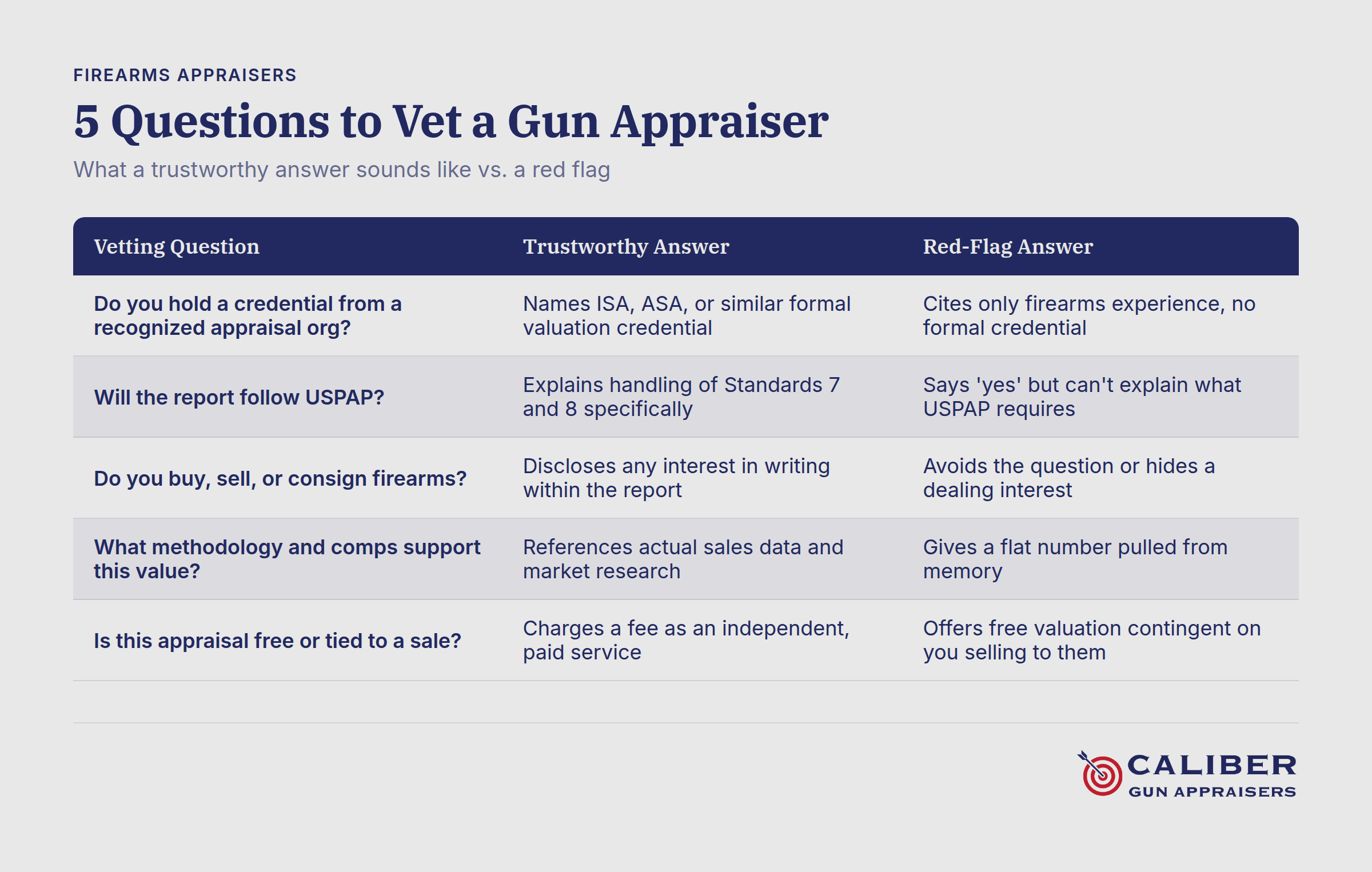
Before you hand a collection to anyone, ask five direct questions and listen for specific, documented answers rather than reassurance.
- Do you hold a credential from a recognized personal property appraisal organization? Credentials from organizations such as the International Society of Appraisers or the American Society of Appraisers signal formal training in valuation methodology, not just familiarity with firearms.
- Will the report be prepared in accordance with USPAP? A yes should come with an explanation of how the appraiser handles Standards 7 and 8, not just the acronym.
- Do you or your business buy, sell, or consign firearms? This isn't disqualifying by itself, but any such interest, current or prior, has to be disclosed in writing in the report.
- What methodology and comparable sales support this value? A credible answer references actual sales data and market research, not a flat number pulled from memory.
- Is this appraisal free, or contingent on you selling to me? A genuine, independent appraisal is a paid professional service. Free valuations tied to a purchase offer are a red flag, not a courtesy.
What a USPAP-Compliant Firearms Appraisal Report Includes
A report that will hold up for the IRS, an insurer, or a court needs more than a single dollar figure. Expect a written document that identifies each firearm individually (manufacturer, model, serial number, caliber or gauge, action type, and condition), states the effective date of value, explains the valuation approach and comparable sales relied on, and includes a signed certification disclosing any assumptions or conflicts of interest. That level of detail is what makes an appraisal usable for an estate tax filing, an insurance claim, or equitable distribution among heirs, and it's the same standard our appraisers apply whether the collection is headed to a probate court, an insurer, or a family split among siblings.
Because our team does not buy, sell, or broker firearms, there's no financial incentive built into the process to steer a value up or down. The report reflects fair market value researched from comparable sales, documented under USPAP, and delivered independent of any purchase transaction.
Protect Your Collection's Value Before You Sell or Settle an Estate
A lowball number rarely comes from bad faith; it usually comes from asking a buyer to also act as your appraiser. Separating those two roles, and insisting on a documented, USPAP-compliant report from a credentialed appraiser with no purchase interest in your firearms, is the single most reliable way to know the number you're given actually reflects fair market value. If you're ready for an independent opinion you can use for insurance, an estate, or a legal matter, request an appraisal from our team and get a report built to the same standard from the first page to the last.
This article is provided for general informational purposes only and does not constitute legal, tax, or financial advice. Readers should consult a qualified attorney or CPA regarding their specific circumstances.