
Blog
How to Determine Your Tax Basis in Inherited or Gifted Firearms
Inherited firearms generally receive a stepped-up basis equal to fair market value on the date of death, while gifted firearms carry over the donor's basis under a double-basis rule when value has dropped. This guide walks through both rules with worked dollar examples so heirs and recipients know what they owe when they eventually sell.
When a firearm passes to a new owner by inheritance or by gift, the tax code does not treat it like a firearm at all. It treats it like any other piece of personal property, and the rules that set its "basis" (the number used to calculate gain or loss on a future sale) depend entirely on how the firearm changed hands. Get the basis wrong and you risk overpaying tax on a sale, or worse, having no documentation to defend your number if the IRS asks. This guide walks through the mechanics for inherited firearms, gifted firearms, and the alternate valuation election, with worked examples at each step.
Firearms appraised for an estate often need the same documentation discussed in our guide to firearm appraisals for estate tax purposes, since the date-of-death value that sets basis is frequently the same figure reported to the IRS on the estate's tax return.
How Is Basis Set for an Inherited Firearm?
An inherited firearm's basis is generally its fair market value on the date the original owner died, not what that owner originally paid for it. This is often called a "stepped-up" basis, though it can just as easily be a step-down if the firearm's value has fallen since purchase.
This rule comes from 26 U.S.C. Section 1014, which sets the basis of property acquired from a decedent at its fair market value at death. The accompanying Treasury regulation confirms the same standard: basis equals fair market value at the date of death, unless the estate elects an alternate valuation date. IRS Publication 551 applies this same basis framework to personal property generally, including collectibles like firearms.
Example: A collector dies owning a pre-64 Winchester Model 70 that he bought decades ago for $400. At his death, a qualified appraisal values the rifle at $3,200. His heir's basis in the rifle is $3,200, not $400. If the heir later sells it for $3,500, the taxable gain is only $300.
The original purchase price, and any records the deceased owner kept, become irrelevant once the step-up applies. What matters is a defensible fair market value as of the date of death, which is exactly why a contemporaneous written appraisal at that date carries so much weight later.
What Happens If I Received the Firearm as a Gift Instead?
A gifted firearm does not get a step-up. Instead, the recipient generally takes on the donor's adjusted basis, a concept known as carryover basis, under the rules in IRS Publication 551.
If the firearm's fair market value on the date of the gift is equal to or higher than the donor's basis, the math is simple: the recipient's basis is the donor's basis (plus a portion of any gift tax paid, in limited cases). The complexity shows up when the firearm has lost value since the donor acquired it.
The Double-Basis Rule
When the gift-date fair market value is lower than the donor's adjusted basis, the recipient actually has two different basis figures to use, depending on what happens at sale:
- For calculating a gain: use the donor's original adjusted basis.
- For calculating a loss: use the firearm's fair market value on the date of the gift.
- If the eventual sale price falls between those two numbers: there is generally no recognized gain or loss at all.
Example: A father's adjusted basis in a vintage shotgun is $10,000. By the time he gifts it to his daughter, collector demand has softened and the gun appraises at $7,000. Three outcomes are possible depending on what she later sells it for:
| Sale Price | Basis Used | Result |
|---|---|---|
| $12,000 | $10,000 (donor's basis) | $2,000 taxable gain |
| $5,000 | $7,000 (gift-date FMV) | $2,000 deductible loss |
| $8,500 | Neither applies cleanly | No recognized gain or loss |
That middle row surprises a lot of recipients. A sale price that lands between the donor's basis and the gift-date value simply produces no gain and no loss to report, even though actual cash changed hands.
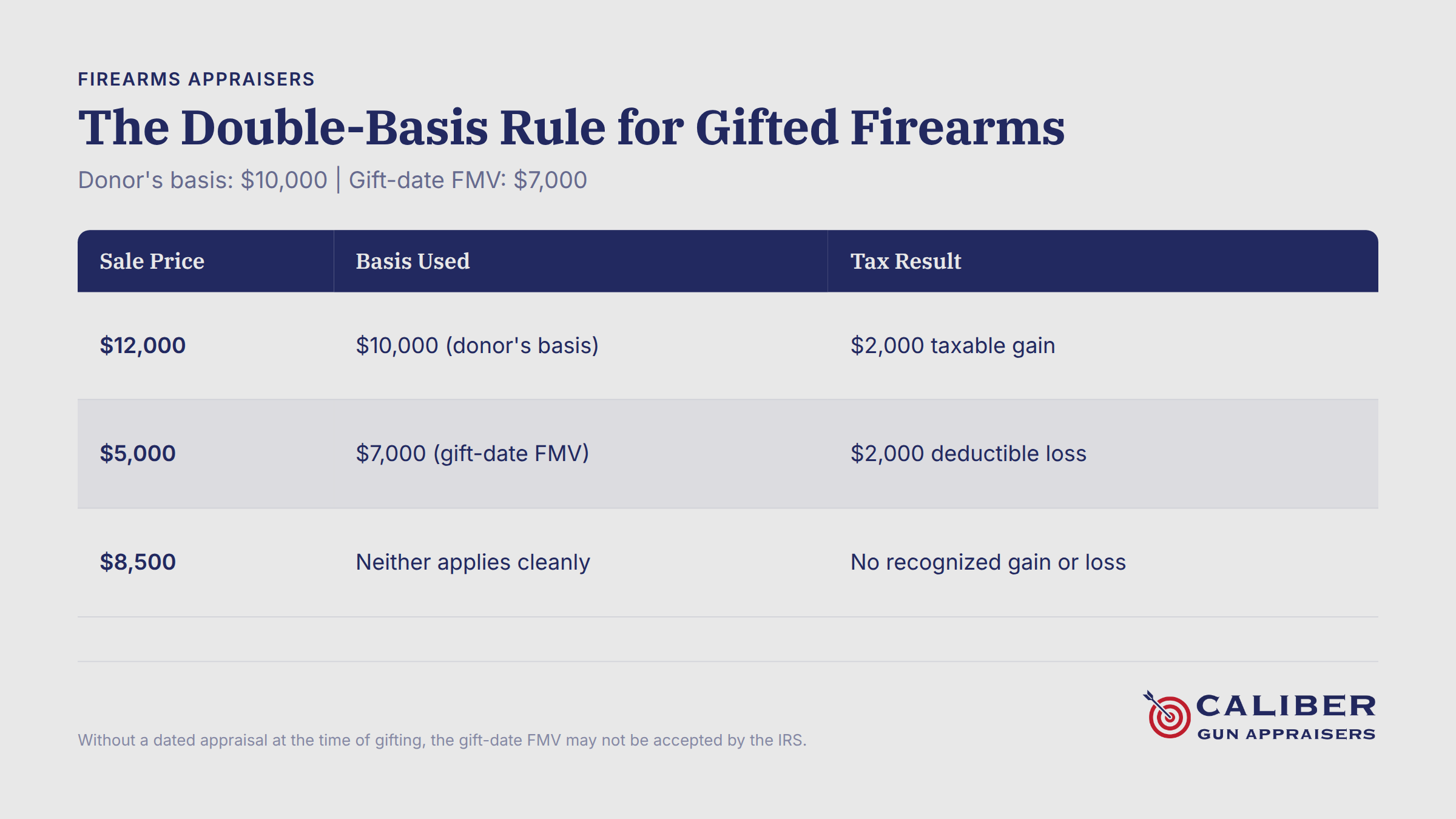
Watch out: Without a written appraisal dated to the gift, there is no way to prove the $7,000 figure existed at the time of transfer. The IRS has no obligation to accept a number reconstructed years later from memory or an online price guide.
How Does the Alternate Valuation Date Change Basis?
An estate's executor can sometimes elect to value all estate assets, including firearms, six months after the date of death instead of on the date of death itself. This election under IRC Section 2032 is only available if it lowers both the gross value of the estate and the resulting estate tax owed; an executor cannot cherry-pick it for one asset or use it simply because it is convenient.
If a particular firearm is sold, distributed, or otherwise disposed of before that six-month mark, it is valued as of the date of disposition instead of the full six-month date. The election applies to the whole estate at once, not asset by asset.
Example: An estate includes a collection of military firearms valued at $150,000 on the date of death. Six months later, driven by a soft collector market, the same collection would appraise at $135,000. If the estate's overall value and tax liability both drop as a result, the executor can elect alternate valuation, and the heirs' basis in the firearms becomes $135,000 rather than $150,000. If one rifle from that collection was sold to a dealer four months after death for $9,000, that rifle's basis is set at its value on the date of that sale, not the six-month mark.
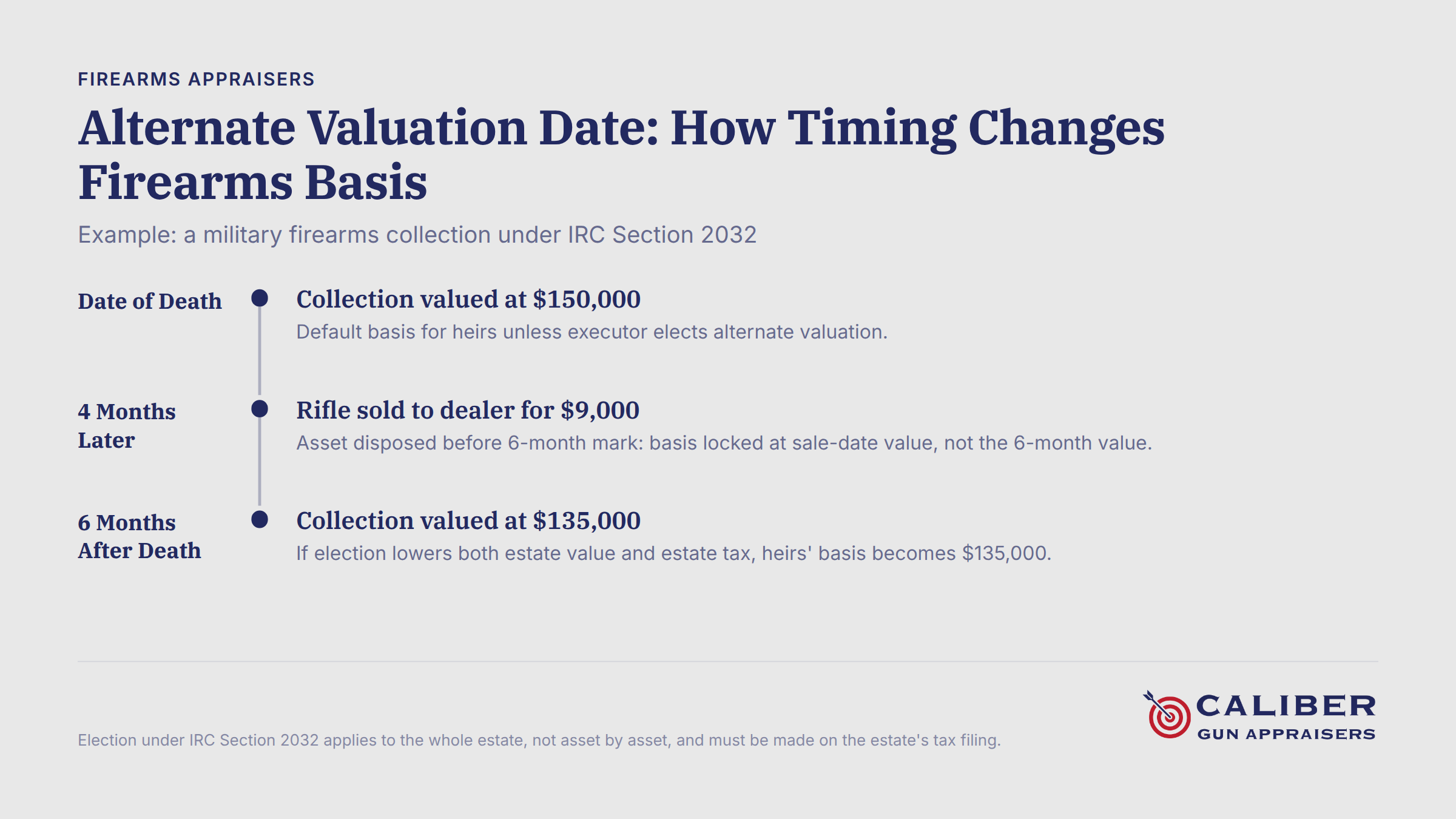
This election is made on the estate's own tax filing, and it has consequences well beyond the firearms. It is not something heirs can request after the fact once the estate's return has been filed and the window has closed.
Why a Contemporaneous Appraisal Matters When You Sell
The single best way to protect a basis figure, whether it came from inheritance, a gift, or an alternate valuation election, is a written appraisal dated to the moment that basis was set. An appraisal performed years after the fact, or a casual online estimate, gives the IRS every reason to challenge the number if a later sale draws scrutiny.
A useful firearm valuation for basis purposes documents several things:
- Identification: manufacturer, model, caliber or gauge, serial number, and configuration.
- Condition: originality, modifications, accessories, and overall completeness.
- Provenance: any historical significance or collector attributes that affect value.
- Market support: comparable completed sales, not simply dealer asking prices.
- Valuation date: the date of death, the date of the gift, or the alternate valuation date, matched precisely to the tax event in question.
Firearms appraisers working in this space typically hold credentials from organizations such as the ISA, ASA, or AAA, and prepare reports in accordance with the Uniform Standards of Professional Appraisal Practice set by The Appraisal Foundation. That standard matters because it is the framework the IRS and courts expect a defensible personal property appraisal to follow.
Heirs managing a larger inherited collection, rather than a single firearm, face an added layer of work: inventorying every item before any of them can be valued or sold. Our guide to appraising an inherited gun collection step by step covers that inventory process in detail, and our Form 706 firearms valuation guide walks through how those same date-of-death values get reported on an estate tax return.
Pro tip: Order the appraisal as close to the date of death or the date of the gift as possible. A report dated months later, reconstructing a past value, is far weaker evidence than one dated to the event itself.
Will the Sale Be Taxed at the Collectibles Rate?
Not automatically. Firearms are not included among the assets Section 408(m) of the tax code defines as collectibles, so a sale does not default to the 28% collectibles capital gains rate the way a sale of coins or fine art might. In most cases, a firearm held for more than a year and then sold is taxed under ordinary long-term capital gains rules.
That said, this is a fact-specific area, and certain firearms with strong collector or historical characteristics may be treated differently depending on how they are classified and sold. Anyone selling a high-value inherited or gifted firearm should confirm the applicable capital gains treatment with a tax professional before filing, rather than assuming one rate or the other applies.
One related point worth a brief mention: firearms regulated under the National Firearms Act follow separate ATF transfer requirements that are independent of these basis rules. A lawful transfer and the resulting tax basis are two separate questions, and clearing one does not automatically clear the other.
Getting the Basis Right Before You Sell
The IRS's general guidance on gifts and inheritances confirms the core principle running through all of this: basis is not something a recipient gets to pick. It is set by law, based on how the firearm was acquired and when, and it determines the gain or loss the recipient will eventually report. The IRS basis of assets topic covers the same framework for property generally.
Heirs and gift recipients who skip the paperwork at the time of transfer often find themselves trying to reconstruct a value years later, usually right when a sale or an IRS inquiry forces the issue. A written, dated appraisal closes that gap. If you have inherited or received a firearm and need that documentation in place before a sale, estate filing, or simply for your own records, our appraisers can prepare a USPAP-compliant valuation tied to the correct date. Request an appraisal to get started.
This article is provided for general informational purposes only and does not constitute legal, tax, or financial advice. Readers should consult a qualified attorney or CPA regarding their specific circumstances.