
Blog
Rock Island Auction and Estate Firearms: When to Consign and When You Need an Independent Appraisal
Searching for a Rock Island Auction estate appraisal? Learn how an auction consignment estimate differs from a USPAP-compliant date-of-death appraisal, and why appraising first protects your Form 706 and your basis.
Heirs who inherit a gun collection often start by searching for a well-known firearms auction house, and that is a reasonable instinct. But a Rock Island Auction estate appraisal search can blur two different jobs: selling guns and documenting what they were worth on the date of death. An auction estimate helps you decide how to sell; a written appraisal documents fair market value as of the date of death for probate and tax purposes.
This guide explains what each document does, how to tell which one you need, and the order that protects an executor. It is written for executors and heirs of a firearms estate, so it focuses on probate and IRS Form 706. If you need the valuation itself, our estate tax gun appraisal service covers it directly.
What Does an Auction House Evaluation or Consignment Estimate Do?
An auction house evaluation is a sales tool. Firearms auction houses generally review a consignor's guns, estimate what they may bring at a future sale, and explain their consignment terms. That estimate looks forward: it reflects expected bidding, the timing of a sale, and how the house plans to present each lot.
A firearms auction house such as Rock Island Auction Company typically offers consignment and may provide a pre-sale estimate. Services, commissions, fees, and terms vary and change over time, so confirm the current details directly with the auction house.
What a consignment estimate generally is not: a formal valuation as of a past date. It is not typically prepared to state fair market value on the date of death, and it is not designed to satisfy a probate court or the IRS. That is not a criticism of auction houses. They are built to sell guns well, and an estate often needs exactly that after the paperwork is done.
What Does a USPAP-Compliant Appraisal Do for Probate and Form 706?
A USPAP-compliant written appraisal states the fair market value of each item as of the date of death, itemizes the collection, and identifies the intended use. It is prepared in accordance with USPAP, the Uniform Standards of Professional Appraisal Practice published by The Appraisal Foundation. The reviewing body, whether a probate court, the IRS, or an insurer, decides what to accept, and no appraiser can promise that outcome.
The IRS defines the standard in its regulations. Under 26 CFR 20.2031-6, fair market value of household and personal effects is the price a willing buyer would pay a willing seller, neither under compulsion and both with reasonable knowledge of the relevant facts. That is a hypothetical, date-specific test, not a prediction of a future auction hammer price.
The stakes are real for larger estates. The Instructions for Form 706 explain that the return is due within 9 months of the date of death, with an automatic 6-month extension available through Form 4768. For decedents dying in 2026, the basic exclusion amount is $15,000,000, and an executor must file if the gross estate plus adjusted taxable gifts and the specific exemption exceed it. An executor may also file solely to elect portability of the deceased spouse's unused exclusion (DSUE). Even estates under the threshold may need a defensible value for basis and for probate inventories.
Undervaluing carries a cost. The same instructions describe a Section 6662 valuation understatement penalty of 20% when the reported value is 65% or less of the actual value, and 40% for a gross understatement (40% or less of actual value). No penalty applies if the resulting underpayment is $5,000 or less.
Auction Estimate vs. Independent Appraisal: Side by Side
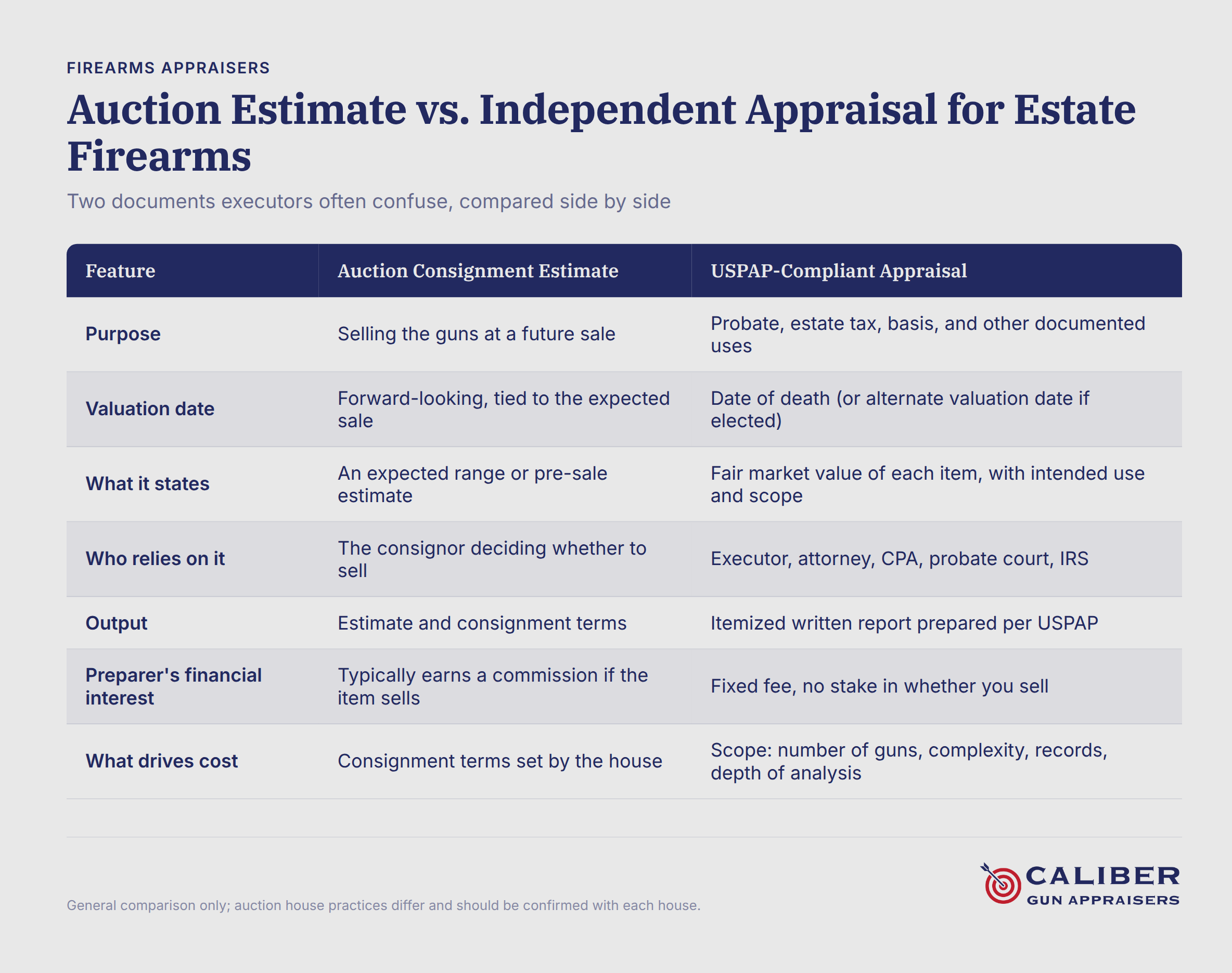
The table below compares the two documents across the points executors most often confuse. It is general in nature, since auction house practices differ and should be confirmed with each house.
| Feature | Auction House Consignment Estimate | USPAP-Compliant Appraisal |
|---|---|---|
| Purpose | Selling the guns at a future sale | Probate, estate tax, basis, and other documented uses |
| Valuation date | Forward-looking, tied to the expected sale | Date of death (or alternate valuation date if elected) |
| What it states | An expected range or pre-sale estimate | Fair market value of each item, with intended use and scope |
| Who relies on it | The consignor deciding whether to sell | Executor, attorney, CPA, probate court, IRS |
| Output | Estimate and consignment terms | Itemized written report prepared in accordance with USPAP |
| Financial interest of the preparer | Typically earns a commission if the item sells | Fixed fee, no stake in whether you sell |
| What drives cost | Consignment terms set by the house | Scope: number of guns, complexity, records, and depth of analysis |
Why Does a 200-Gun Collection Need Careful Documentation?
A large collection needs an organized inventory before any valuation, because the details that move value are specific to each firearm. Picture an example scenario: a family in Midland, Texas inherits more than 200 guns and needs a formal appraisal for probate and Form 706. Nothing about the family or the numbers is real, but the problem is common.
For each firearm, the appraiser needs details such as:
- Make, model, and serial number: The serial number can place a gun in a specific production range.
- Condition and originality: Refinishing, replaced parts, and wear can change value significantly.
- Matching numbers: Whether major components carry matching serials matters for many collectible arms.
- Accessories and documentation: Factory letters, original boxes, and papers support a higher value.
- Provenance: A documented history can distinguish a good gun from an exceptional one.
A collection this size may call for in-person inspection or very detailed photo documentation, depending on the guns and the records. Small estates rarely need an on-site visit. Our appraisers scope each engagement individually. For a step-by-step approach to the inventory itself, see our guide to appraising an inherited gun collection.
Fees follow scope: the number of firearms, their complexity, the quality of the records, the intended use, and the depth of analysis required. We quote a fixed fee before work begins and never bill hourly. We do not state turnaround times in advance because they depend on the same scope factors.
Pro tip: Photograph every gun, its serial number, and any markings before anyone visits the collection. Good photos speed up both an appraisal and an auction consignment review.
How Do NFA Items Change the Plan?
NFA items such as suppressors, short-barreled rifles, and machine guns follow federal transfer rules no matter where they are sold or who inherits them. The venue does not remove those requirements. An executor should treat these items as a separate track with special handling, and should involve a licensed attorney plus the FFL/SOT dealer who will handle any transfer.
We cover the mechanics in more depth in our post on how NFA firearm transfers from an estate to heirs work. The key point for valuation is that NFA items often carry significant value and need careful documentation, so list them clearly and do not move them until the transfer path is confirmed.
What Role Does an FFL Play When Estate Guns Are Sold or Passed On?
Estate firearms that are sold through an auction house or sent to out-of-state heirs generally move through a licensed dealer (an FFL). State laws vary, and the rules for heirs in different states can differ from the rules where the estate is administered. Confirm the specifics with an estate attorney before any gun leaves the property.
Until then, keep the guns secured and stored safely in place. Avoid moving them across state lines before you have checked the rules. Documenting the collection in place is also simpler than documenting it after it has been scattered.
Who Qualifies to Sign the Appraisal for Form 706?
For valuable articles, the regulation calls for an expert appraisal under oath, and the appraiser should be disinterested and qualified. Under 26 CFR 20.2031-6, when articles of marked artistic or intrinsic value total more than $3,000, an appraisal by an expert or experts, under oath, is filed with the return. The executor also submits a statement under penalties of perjury about the completeness of the itemized list and the disinterested character and qualifications of the appraiser. Appraisers should be reputable and of recognized competency for the class of property.
Firearms are not named in the regulation's list of examples (jewelry, furs, silverware, paintings, antiques, books, and coin or stamp collections). Estates commonly treat valuable gun collections the same way, but the executor should confirm with the estate's CPA or attorney.
On the question of disinterest, a general principle applies: a business that stands to earn a commission if the guns sell has a financial interest in the sale. That does not make a firm's judgment wrong, and this is not a comment on any named company. It simply means that for a document certifying date-of-death value, an independent appraiser who is not buying or consigning the guns is the cleaner choice. Our appraisers hold credentials with leading organizations such as the ASA, ISA, and AAA. When you vet any appraiser, our guide to finding a trustworthy gun appraiser lays out what to ask.
How Can Auction Results Help Later?
Realized auction prices for comparable guns are useful market evidence, both for an appraiser and for an heir weighing a sale. A result is a data point about what a willing buyer actually paid, which is why appraisers study sold prices rather than asking prices. The difference between the two matters a great deal, and our post on gun auction sold prices vs. asking prices explains how to read the data.
Timing matters too. A sale that happens after the date of death is evidence of value, but the appraisal must still state value as of the date of death. A later result may support or challenge that value; it does not replace it. Auction results can also help an executor decide whether a sale makes sense.
Why Does Date-of-Death Value Matter for Basis?
Under section 1014 of the Internal Revenue Code, property acquired from a decedent generally takes a basis equal to its fair market value at the date of death (or the alternate valuation date, if elected under section 2032). Section 1014(f) also provides that, for property whose inclusion increased estate tax, basis cannot exceed the final estate tax value. That is how a documented date-of-death value later controls gain or loss on a sale. The Form 706 instructions also describe consistent basis reporting: for estates required to file, each asset's estate tax value must be reported to the IRS and the beneficiary on Form 8971 within 30 days of the Form 706 due date, including extensions.
Example: A rifle is appraised at $9,000 as of the date of death. An heir later sells it at auction for $11,500. The gain is $2,500 against the stepped-up basis, before any auction fees. Without a documented date-of-death value, proving that basis becomes much harder. This is an illustration only, not tax advice.
What Is the Right Order: Appraise First, Then Decide Whether to Sell?
Appraise first for date-of-death value and basis, then decide whether to consign. Selling before the value is documented can create avoidable problems, and the regulations address disposing of household effects ahead of an IRS investigation, which requires an appraisal and statements. A practical sequence for an executor looks like this:
- Secure and Inventory the Collection
- Lock the guns down, keep them in place, and list make, model, and serial numbers with photos.
- Check With the Attorney and CPA on Filing Needs
- Confirm whether Form 706 is required, whether to file for portability, and who will review the appraisal.
- Commission the Date-of-Death Appraisal
- Engage an independent appraiser to prepare a USPAP-compliant report stating fair market value as of the date of death.
- Decide to Keep, Distribute, or Sell
- Heirs can choose item by item, using the appraisal as the baseline.
- Get Consignment Estimates and Compare Terms
- Ask each auction house about commissions, fees, schedules, and handling of NFA items, and compare in writing.
- Report Sales and Basis Consistently
- Make sure the values used on Form 706, Form 8971, and later sale reporting all line up.
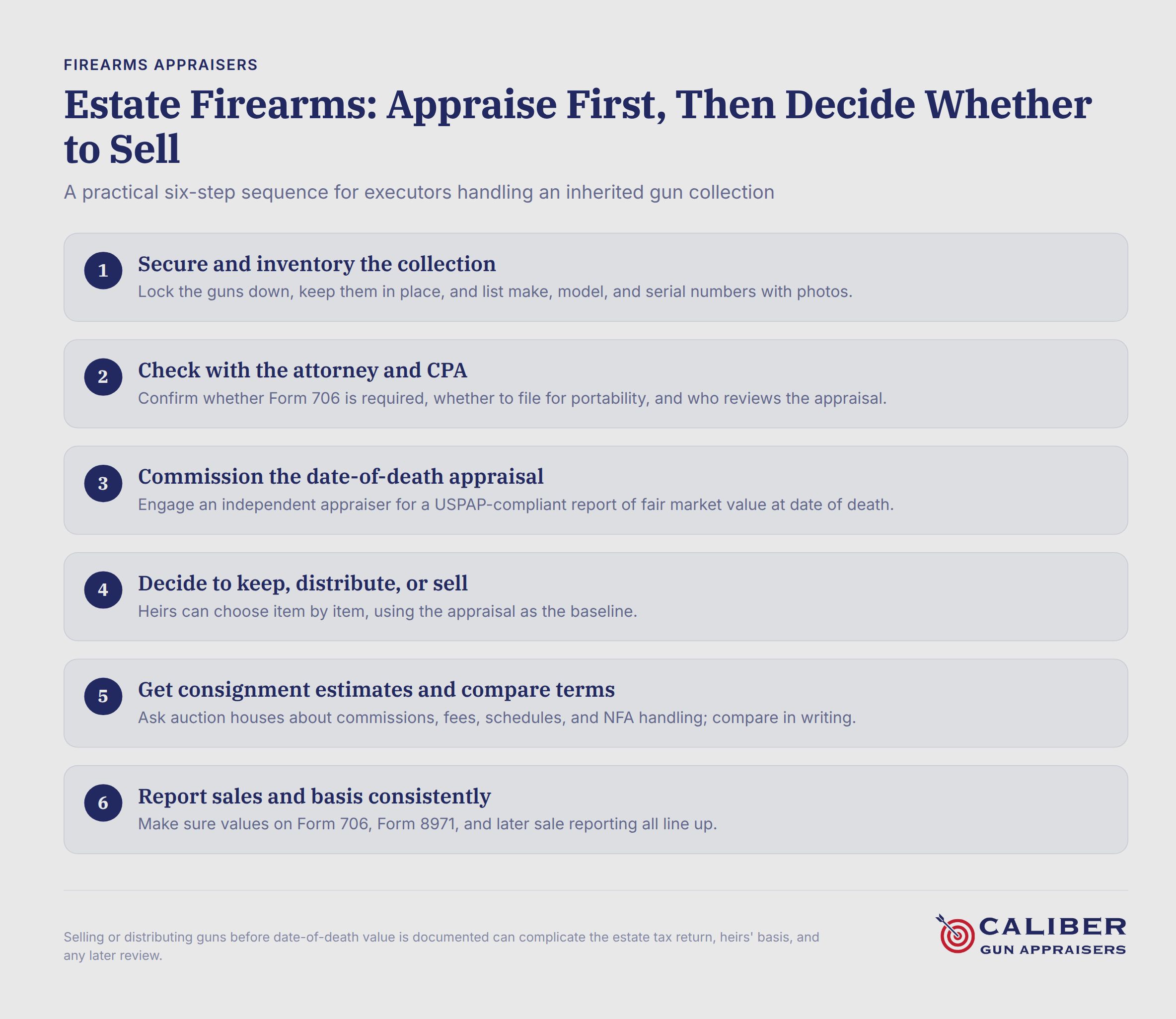
Watch out: If guns are sold or distributed before date-of-death value is documented, the executor may have no defensible record of what they were worth that day. That gap can complicate the estate tax return, the basis for heirs, and any later review.
Frequently Asked Questions
Q: Can I get a free auction estimate and still get a separate appraisal? Yes. The two serve different purposes, so an estimate does not replace an appraisal and does not prevent one. Just confirm the auction house's terms before you sign anything, and keep the date-of-death appraisal independent of any consignment decision.
Q: Does it matter if an auction estimate range is lower or higher than the appraised value? Not for the appraisal. The estimate reflects expected sale conditions, while the appraisal states fair market value on a past date. Differences between the two are normal and are not evidence that either document is wrong.
Q: Should I photograph the collection before anyone visits? Yes. Clear photos of each gun, its serial number, and its markings create a record of the collection as it stood. They also reduce the chance of confusion about which guns were present at the date of death.
Q: Can heirs split a collection between keeping and selling and use one appraisal for both? Yes. A single itemized appraisal can support both: guns that heirs keep carry their date-of-death value as basis, and guns that are sold are measured against it. Ask your attorney or CPA how to track each item's basis.
Document the Value Before You Decide What to Sell
Auction houses and independent appraisers do different jobs, and an estate usually benefits from both in the right order. Document the collection, get the date-of-death value in writing, then explore consignment with the numbers in hand. When you are ready to start, request an estate firearms appraisal from our team and we will scope a fixed fee before work begins.
This article is provided for general informational purposes only and does not constitute legal, tax, or financial advice. Readers should consult a qualified attorney or CPA regarding their specific circumstances.