
Blog
What Dollar Threshold Triggers an IRS Qualified Appraisal for Firearms Collections?
The IRS requires a qualified appraisal for a firearms donation once the claimed deduction passes $5,000, but estate tax filings apply a lower $3,000 line and gift tax works on a different standard entirely. This guide breaks down the Form 8283, Form 706, and Form 709 thresholds so firearms owners know exactly when a qualified appraiser becomes a legal requirement.
A firearms collection can trigger an IRS qualified appraisal requirement in three completely different tax contexts, each with its own dollar threshold and its own rules for what the appraisal must say. Miss the right one and a charitable deduction gets denied, an estate return gets flagged, or a gift tax statute of limitations never starts running. This guide walks through the actual thresholds for donations, estates, and gifts, using a firearms collection as the working example throughout, and our firearms appraisal team prepares reports built to meet each one.
Charitable Donations: When Form 8283 Requires a Qualified Appraisal for Firearms
A firearms donation requires a qualified appraisal once the claimed deduction for the firearm, or for a group of similar firearms, exceeds $5,000. Below that line the paperwork is lighter. Above it, Form 8283 Section B and a written appraisal from a qualified appraiser become mandatory.
The IRS Form 8283 instructions lay out a tiered reporting structure for noncash charitable contributions:
- $500 or less: No Form 8283 is required at all for the contribution.
- Over $500 up to $5,000: The donor files Form 8283, Section A, with a description of the property and how it was valued, but a formal qualified appraisal is not required.
- Over $5,000: The donor must obtain a qualified appraisal and complete Form 8283, Section B, which the appraiser signs along with an authorized representative of the receiving charity.
- $500,000 or more: A complete, signed copy of the qualified appraisal must be attached directly to the tax return, not just the appraisal summary.
That $5,000 line is rarely about a single rifle on its own. The IRS treats a donation of similar items of property as one combined contribution for purposes of the threshold, which matters enormously for firearms collectors giving multiple pieces to the same institution or cause.
Example: A donor gives a museum 15 vintage hunting rifles, none individually appraised above $900. No single rifle clears $5,000, but the aggregate claimed deduction for the group comes to $13,500. Because the rifles are "similar items" under the aggregation rule, the donor needs a qualified appraisal and Section B reporting for the whole collection, not an exemption because each piece looks modest alone.
There is also a narrower rule worth flagging for higher-value pieces: Treasury regulations governing noncash charitable contributions require a qualified appraisal and, for property valued at $20,000 or more that falls into categories treated like fine art, require the complete signed appraisal (not just a summary) to accompany the return. A plain production firearm won't trip this rule, but an engraved presentation piece, a historically commissioned gun, or a firearm genuinely marketed and appraised as a decorative art object can land in that category, so it's worth raising with your appraiser rather than assuming it doesn't apply.
For a deeper walkthrough of how this plays out specifically for gun collections, see our guide on donating a gun collection for a tax deduction.
Estate Tax: a Lower $3,000 Line for Collectible Firearms (Form 706)
Estate tax works on a different, lower threshold than charitable giving. An executor generally must obtain a sworn appraisal from a qualified appraiser for any article, or collection of similar articles, of artistic or collectible value once that value exceeds $3,000. Firearms with historical, collectible, or antique character, including Curio & Relic pieces, fall squarely inside this rule even though an ordinary working hunting rifle usually would not.
This standard comes from the same body of Treasury regulation that governs estate tax valuation of household and personal effects, and it requires the appraisal to be made under oath, meaning the appraiser signs a sworn statement attesting to the value and the basis for it. That's a materially different bar than the Form 8283 process, which relies on a signed declaration rather than a sworn oath.
Two details trip up executors handling firearms estates more than anything else:
- The threshold is per item or per collection, not per estate. A single collectible revolver worth $4,000 triggers the requirement on its own; so does a box of twelve surplus rifles that individually sell for $300 but aggregate to $3,600 as a "collection of similar items."
- Condition and provenance drive value more than caliber or brand. A firearm's estate value often has little to do with what a retail buyer would pay for a comparable new gun and everything to do with rarity, documented history, and collector demand, which is exactly why a sworn appraisal matters more than a dealer's quote.
Our firearms estate appraisal service prepares the sworn reports executors need to file Form 706 with values that hold up if the IRS asks questions later.
Gift Tax: No Universal Threshold, But Documentation Still Starts the Clock (Form 709)
Gift tax carries no single statutory dollar figure that triggers a mandatory qualified appraisal the way donations and estates do. Instead, the rule is about adequate disclosure: if a gifted firearm or collection isn't described and valued well enough on Form 709, the IRS can reopen and reassess that gift's value years, sometimes decades, later.
The practical effect is that a qualified appraisal becomes the simplest way to meet the adequate disclosure standard, even though no regulation says "you must appraise every gift over $X." Without one, the statute of limitations on that gift's valuation may never start running, leaving the value exposed to challenge indefinitely. With a qualified appraisal attached and the gift adequately described, the normal three-year assessment window begins and the value becomes final once that window closes.
For firearms specifically, this matters most when gifting a collection during life rather than waiting for it to pass through an estate: a documented, dated, sworn-quality appraisal at the time of the gift protects both the giver and the recipient from a valuation dispute that surfaces long after memories and comparable sales data have faded.
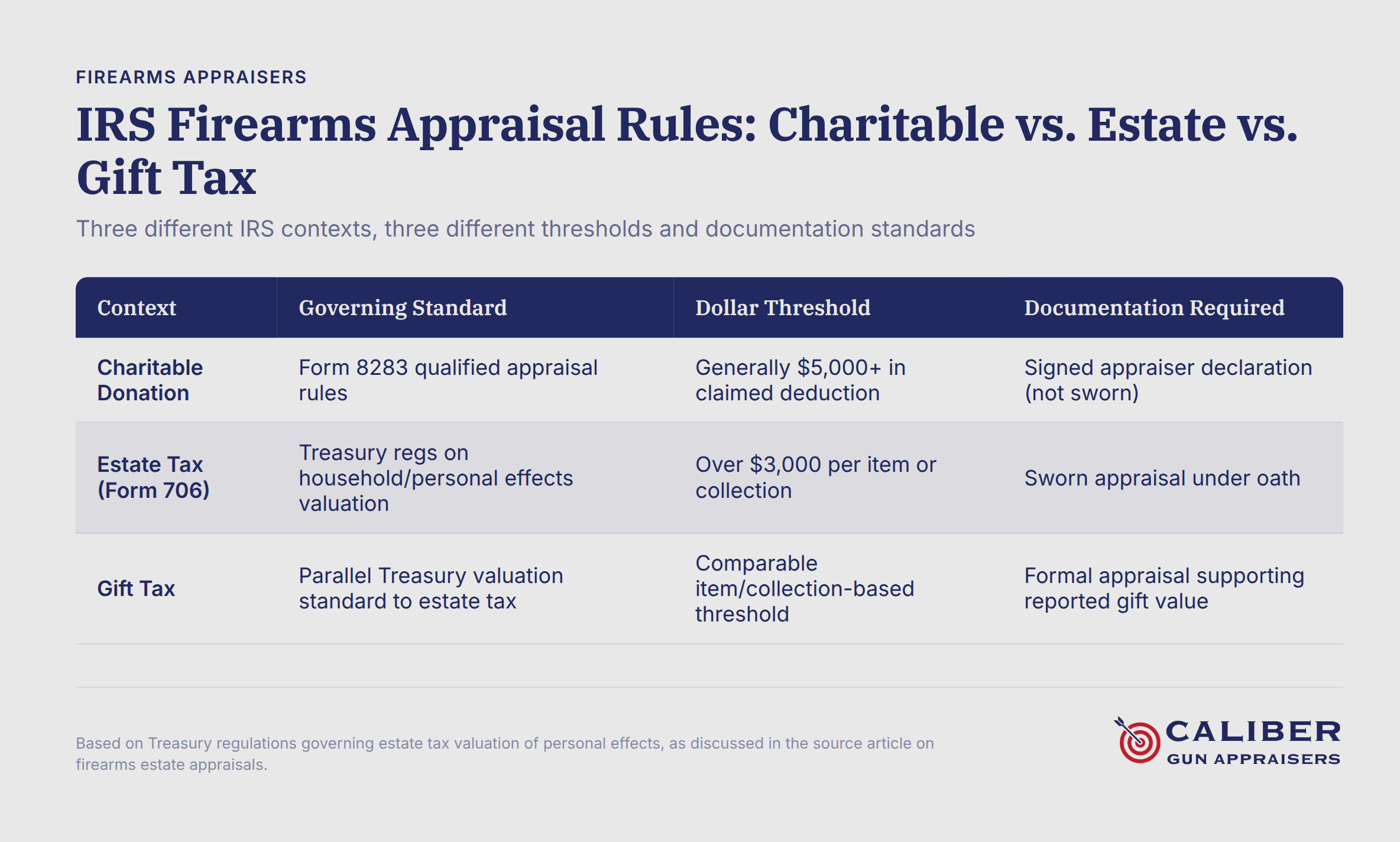
Comparing the Three Thresholds at a Glance
The dollar line that matters depends entirely on which tax event you're dealing with, which is the single most common point of confusion for firearms owners and their estates.
| Context | Governing Standard | Dollar Threshold | What's Required |
|---|---|---|---|
| Charitable donation (Form 8283) | IRS noncash contribution rules | More than $5,000 (aggregated for similar items) | Qualified appraisal, Section B reporting, full attachment at $500,000+ |
| Estate tax (Form 706) | Treasury regulation on household and collectible effects | More than $3,000 per item or per collection | Sworn appraisal under oath by a qualified appraiser |
| Gift tax (Form 709) | Adequate disclosure standard | No fixed dollar line | Qualified appraisal recommended to document value and start the statute of limitations |
Why NFA Items and Antique Firearms Trigger These Thresholds Unexpectedly
Firearms owners are frequently caught off guard because the thresholds above assume someone knows the collection's real value before filing, and collectible or NFA-regulated firearms routinely carry far more value than their retail-market cousins. A pre-1986 transferable machine gun, for instance, can be worth tens of thousands of dollars on today's collector market even though a comparable semi-automatic rifle might sell for a few hundred dollars. One NFA item sitting in an estate can blow past the $3,000 estate threshold by itself, before anything else in the gun safe is even counted.
Curio & Relic antiques create the opposite problem: individually modest value that becomes significant once aggregated. A dozen surplus C&R rifles at $300 apiece looks negligible gun by gun, but as a "collection of similar items" for either donation or estate purposes, that group crosses $3,600, triggering an appraisal requirement that nobody budgeted for.
Watch out: Suppressors, short-barreled rifles, and other NFA items also carry transfer and registration considerations that a generalist appraiser may not understand. Valuing them accurately, and documenting that value defensibly, calls for an appraiser familiar with both the collector market and the regulatory status of the item itself.
Our appraisers prepare reports in accordance with USPAP (the Uniform Standards of Professional Appraisal Practice published by The Appraisal Foundation), which is the standard reviewing bodies expect regardless of which tax form the appraisal supports.
What a Qualified Firearms Appraisal Costs
An IRS-qualified firearms appraisal is quoted as a fixed fee before work begins, never billed by the hour. Our Advanced, IRS-qualified firearms appraisals start at $295, with typical engagements for a single collectible piece or a small group running $395 to $2,200 depending on the number of firearms, the completeness of existing records, and whether the report needs to meet donation, estate, or gift tax standards. Highly complex engagements, including large aggregated collections or NFA pieces with documented provenance, can run $1,600 to $3,500 or more. The fee reflects the scope of the work, not the value of the guns themselves.
Get the Threshold Right Before You File
The dollar figure that matters for a firearms appraisal depends entirely on why you need one. A donation lives or dies on the $5,000 aggregate threshold and the Section A versus Section B distinction. An estate return turns on the lower $3,000 line and a sworn appraisal under oath. A gift tax filing has no fixed number at all, but an undocumented gift can stay exposed indefinitely without one. Getting the right threshold, and the right type of report, in place before you file is far cheaper than fixing a denied deduction or a reopened estate valuation later.
If you're preparing to donate, settle an estate, or document a gift involving firearms, request an appraisal from our team and we'll scope the report to the specific IRS form it needs to support.
This article is provided for general informational purposes only and does not constitute legal, tax, or financial advice. Readers should consult a qualified attorney or CPA regarding their specific circumstances.