
Blog
Is the Blue Book of Gun Values Still Accurate for Today's Firearm Market?
The Blue Book of Gun Values gives collectors a useful price benchmark, but whether it is accurate for a specific firearm today depends on how it gathers data and how finely it grades condition. This guide explains what the book measures, where it falls short, and when a professional firearm appraisal fills the gap.
Collectors and dealers have leaned on the Blue Book of Gun Values for decades as the default answer to "what's this worth?" It is a real reference tool built from genuine market research, not a guess. But a price guide and a professional appraisal answer different questions, and conflating the two is where collectors run into trouble, especially for estate planning, insurance, or a sale involving real money.
Our gun appraisal service exists precisely because a printed guide, however well researched, cannot account for the specific condition, provenance, and originality of the firearm sitting in front of you. This article looks at how the Blue Book actually builds its numbers, what changed in its most recent editions, and where the line falls between "good enough to start" and "you need a credentialed appraiser."
What the Blue Book of Gun Values Actually Measures
The Blue Book is built from an analysis of prices at which collectible firearms are actually changing hands at an average retail level, drawing on gun and trade shows, auction results, dealer input, and collector and historian feedback. That research base makes it far more than a theoretical price list.
But "average retail value" is a specific, narrower thing than people often assume. It is not the same as a dealer's cash offer, a private-party sale price, an auction hammer price, a gun-show asking price, or the replacement cost of a comparable firearm. Each of those numbers can differ from the Blue Book figure for the same gun, sometimes by a wide margin, and none of them is wrong. They are just measuring different transactions.
The Newest Editions Shifted Their Data Sourcing
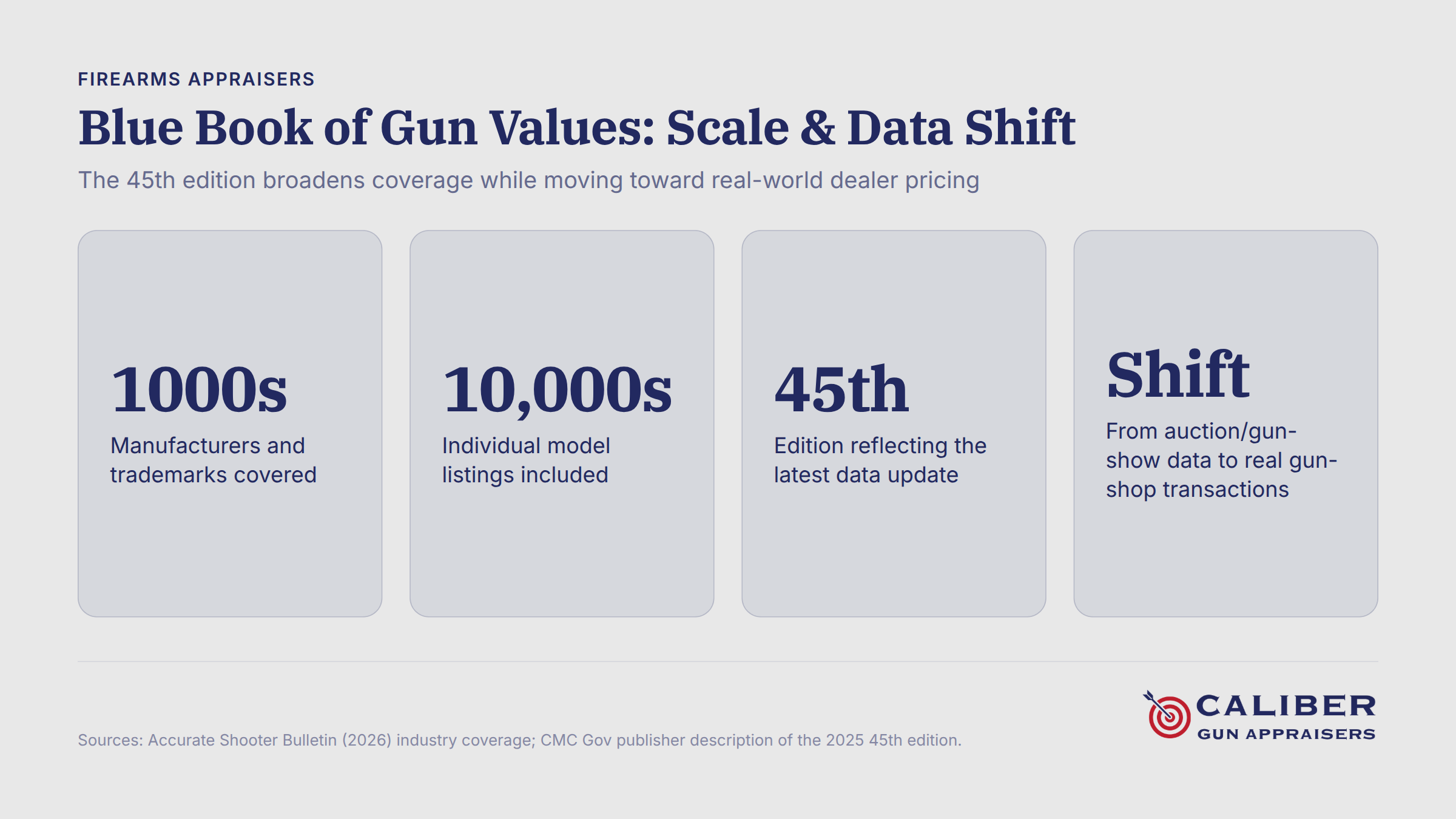
The most recent edition of the Blue Book moved toward pricing built from real-world, current gun-shop transactions, a departure from earlier editions that leaned more heavily on auction results and gun-show sale data, according to industry coverage of the update. That is a meaningful shift. Dealer floor pricing tends to track everyday retail demand more closely than a data set weighted toward collectible auctions, which can be skewed by rare lots or motivated bidders chasing a specific piece.
The scale of these editions is substantial. A recent 45th edition continues the book's tradition of covering thousands of manufacturers and trademarks and tens of thousands of individual model listings, according to its publisher description. That breadth is exactly why the guide works well as a starting framework: almost any gun a collector owns will show up somewhere in it.
Why a Printed Price Guide Will Always Lag the Real Market
A price guide is a snapshot, not a live feed. Editors compile data, lock in values, and publish on a fixed cycle, typically annually. Completed auction and gun-show sales, by contrast, reflect whatever buyers are willing to pay on that specific day, in that specific room, against whoever else happens to be bidding.
That structural gap means a guide can be entirely accurate as of its compilation date and still be stale by the time a collector is holding the book. A model that spikes in demand after a manufacturer discontinues it, a politically sensitive firearm that sees a sudden buying wave, or a regional market with unusual supply, all of these can move faster than any annual publishing cycle can track. The guide's own long-standing descriptions acknowledge that values respond to supply, demand, and speculation, forces that do not wait for the next print run.
This lag is not a flaw unique to the Blue Book. It is true of every static price reference, in firearms or any other collectible category. The publication's reputation as, in one trade write-up, an invaluable reference for collectors rests on consistency and breadth, not on real-time precision, per Shooting Sportsman's overview of the guide.
The NEG/NGF Grading System Simplifies, But Variation Still Hides Inside It
Recent editions streamlined the book's old multi-tier condition scale into a leaner NEG/NGF framework (New, Excellent, Good, Fair). That simplification makes the guide faster and more consistent to use, but it also compresses a lot of value-relevant detail into just a few buckets.
Two firearms both graded "Excellent" in the same model listing can still differ meaningfully in actual value once you account for:
- Production year and variant within the model run
- Originality of finish versus refinishing or refurbishment
- Matching serial numbers and factory-correct parts
- Surviving factory documentation, letters, or provenance
- Import marks, modifications, or non-factory alterations
- Bore condition, mechanical function, and finish percentage
A broad model-line entry simply cannot encode all of that. It gives you a reasonable midpoint for "a gun like this one," not a verdict on the specific gun in your safe.
Watch out: Condition grading is also subjective by nature. A grade a guide (or one dealer) assigns does not automatically match how another dealer, an auction house, or a professional appraiser would grade the identical firearm. If your estimate of value rests entirely on a self-assigned condition grade, treat that number as a starting point, not a conclusion.
Price Guide vs Professional Appraisal: What Each One Actually Tells You
A price guide and a formal appraisal serve different purposes, and the table below lays out where each one is strongest.
| Feature | Price Guide (Blue Book) | Professional Appraisal |
|---|---|---|
| Data source | Compiled retail, auction, and gun-shop data across many transactions | Direct physical inspection plus researched comparable sales for the specific firearm |
| Update cycle | Annual or multi-year print/edition cycle | Prepared fresh as of a specific effective date |
| How condition is judged | Self-assessed against a general grading scale (NEG/NGF) | Hands-on inspection by a trained appraiser, documented in the report |
| Best use case | Quick ballpark reference, initial research, narrowing a price range | Estate, insurance, divorce, litigation, donation, or sale of a rare or high-value firearm |
Our team treats a price guide the same way an appraiser does: as a useful framework, never a substitute for inspection-based valuation. A defensible report relies on the sales comparison approach, researching actual completed comparable sales for the firearm in question, not retail list pricing pulled from a guide. That distinction matters most when real money, a tax filing, or a legal proceeding is riding on the number.
Pro tip: Before you accept any book value at face value, pull your own comparable sales. Check recent completed auction results and gun-shop listings for the identical model, caliber, and configuration, then compare those against the guide's figure. If they line up, you have a reasonable number. If they diverge sharply, that gap is a signal the guide's broad category does not fit your specific firearm.
When a Collector Should Get a Professional Firearm Appraisal Instead
A price guide is usually enough for casual research or a rough sense of value. It stops being enough once the stakes, rarity, or legal context change.
Consider a professional appraisal, prepared in accordance with USPAP, when any of the following apply:
- The firearm is rare, antique, or historically significant, where comparable sales are sparse or wildly inconsistent
- Originality is in question, such as unclear refinishing, replaced parts, or disputed provenance
- The valuation needs to hold up in an estate, insurance claim, divorce, or litigation matter, where a defensible, documented report carries real weight
- You are donating firearms and need a qualified appraisal to support an IRS filing
- A collection includes multiple guns at very different value tiers, where a single blanket book estimate would misstate several of them
Our guide to finding a trustworthy gun appraiser walks through what separates a credentialed professional from a dealer offering a quick, self-interested number. Appraisers working in this space typically hold credentials through organizations such as ASA, ISA, AAA, or CAGA, and prepare reports consistent with USPAP and the standards set by The Appraisal Foundation.
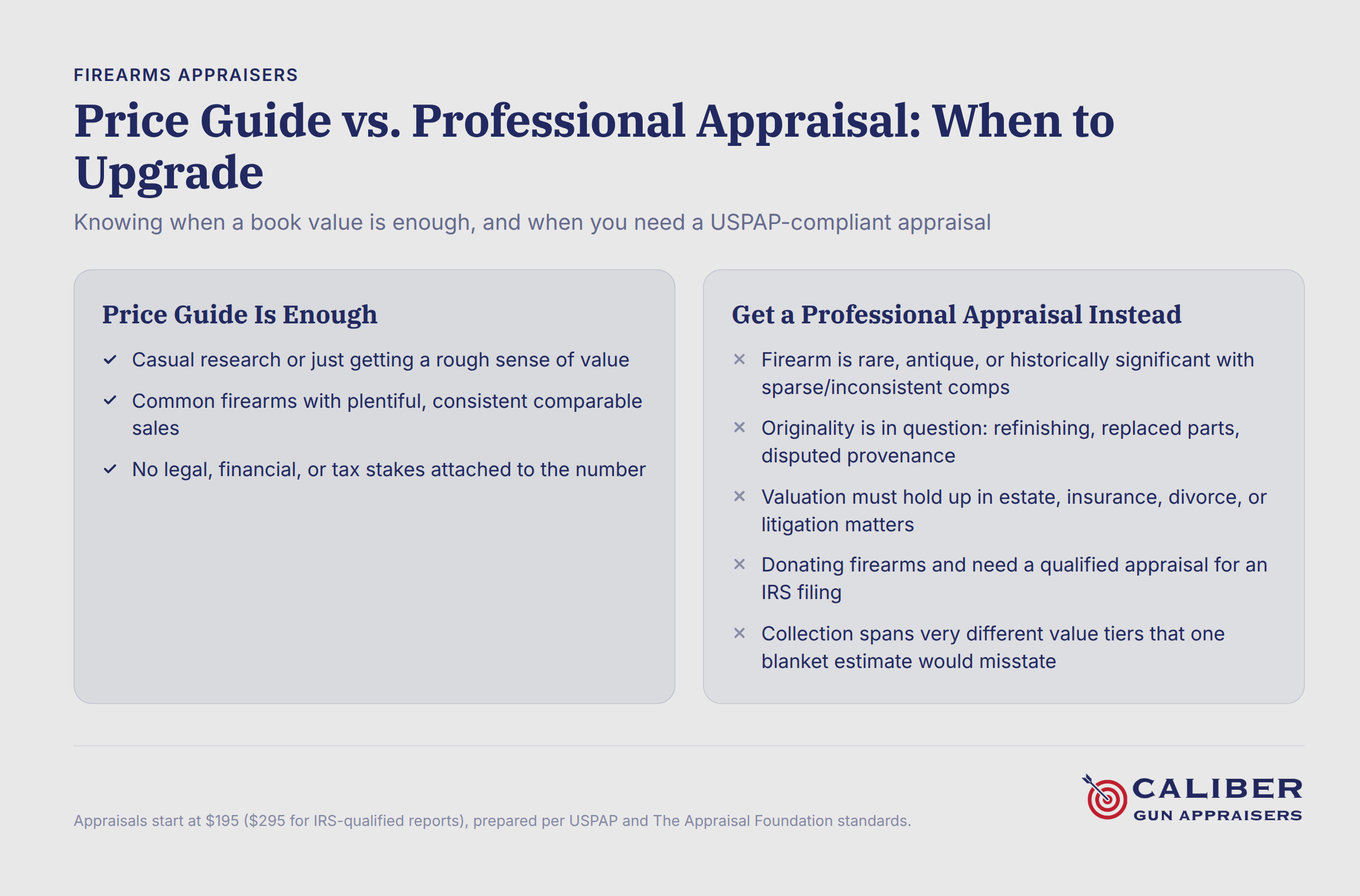
Fees for a firearm appraisal are quoted as a fixed amount after we understand the scope: how many guns, how much research the comparable sales require, and whether the report needs to meet IRS-qualified standards for a donation or estate filing. Our standard personal firearm appraisals start at $195, with IRS-qualified reports starting at $295; engagements are never billed hourly. Readers curious about how pricing scales with collection size and complexity can see how those factors play out.
The Book Is a Starting Point, Not the Final Word
The Blue Book of Gun Values earns its reputation honestly. It is built from real transaction research, it covers an enormous range of makes and models, and its shift toward current gun-shop pricing is a genuine improvement in timeliness. For a quick read on a common model in average condition, it remains one of the better references available, and collectors asking whether there's a Kelley Blue Book equivalent for firearms will find the Blue Book is the closest thing the hobby has.
What it cannot do is inspect your specific firearm, verify its originality, or stand up as documented evidence in a tax, insurance, or legal matter. That gap is where a credentialed appraisal earns its fee. If a decision of real consequence is riding on the number, treat the book as your first step, not your last one.