
Blog
Replacement Value vs Fair Market Value for Firearms: What Your Insurance Appraisal Must State
Replacement value and fair market value are not interchangeable numbers on a firearm appraisal, and using the wrong one can leave a collector underinsured after a loss. This guide explains both standards, how policies apply them, and why the appraisal must say which one it used.
A firearm appraisal that doesn't state its value standard is a document with a hole in it. Two collectors can own the same discontinued rifle, hand nearly identical appraisals to their insurer, and end up with wildly different settlement checks after a fire or theft, simply because one report was written to fair market value and the other to replacement value. This matters most for discontinued and collectible firearms, where the gap between what the gun is worth on the used market and what it costs to replace today can run into the thousands.
Getting this right starts before a loss happens. Our firearm appraisal for insurance coverage service is built specifically to match the appraisal's value standard to the policy language, so the number on the schedule actually protects the collector. If a loss has already occurred, our firearm appraisal for insurance claim service documents the correct value standard for settlement negotiations.
Two Different Numbers, Two Different Questions
Fair market value and replacement value answer two different questions, and confusing them is the single most common mistake in firearm insurance appraisals. Fair market value asks what a willing buyer would pay a willing seller for this specific gun, in its actual condition, in the market where it typically trades. Replacement value asks what it would cost to buy a new item of like kind and quality today, without any deduction for age or wear.
For common, currently produced firearms, these two numbers often land close together. For discontinued models, custom work, and anything with collector demand, they can diverge sharply, and the direction of that gap isn't always intuitive.
What Is Fair Market Value for a Firearm?
Fair market value is the price a specific firearm would bring between a willing buyer and a willing seller, neither one under pressure to act, based on recent sales data for that make, model, and condition. Appraisers build this figure from auction results, dealer transactions, and condition-grading standards specific to the firearm.
An insurance guide aimed at firearm owners defines actual cash value or fair market value as the cost to replace an item with one of similar kind and quality, minus depreciation, assuming neither party is under duress to buy or sell, which is the same arm's-length standard used across the broader insurance industry (Leavitt Group). That depreciation piece is what separates fair market value from a simple retail price tag. A used firearm's fair market value reflects its actual condition, its actual scarcity, and what that specific gun is realistically trading for right now, not what a brand-new equivalent costs.
What Is Insurance Replacement Value for a Firearm?
Replacement value (also called replacement cost value, or RCV) is the cost to buy a new firearm of like kind and quality today, with no deduction for age, wear, or obsolescence. State insurance regulators describe replacement cost value as the money needed to replace belongings at the current cost of similar items, as opposed to actual cash value, which factors in the decrease in value from age or use (North Carolina Department of Insurance).
For a discontinued firearm, "like kind and quality" usually means the closest current-production equivalent, not a used unit identical to the one lost. That distinction is exactly where underinsurance shows up: if the appraisal was written to fair market value but the policy pays replacement cost, the collector may be paid less than it actually takes to replace the gun. If the appraisal was written to replacement value but the policy only covers actual cash value, the collector may be over-scheduling and paying premium for coverage they can't actually collect on.
Actual Cash Value vs Replacement Cost Coverage
Most homeowners policies default to paying actual cash value (ACV) on personal property, including unscheduled firearms, unless the policyholder has added a replacement cost endorsement. ACV is most commonly calculated as replacement cost new minus depreciation, though courts in some jurisdictions apply a broader test that considers any relevant evidence of a specific item's value (PropertyCasualty360).
A New York Department of Financial Services opinion confirms this split directly: homeowners policies can be written on either an actual cash value or a replacement cost basis, and under an ACV policy the amount payable is the current replacement cost minus wear, tear, and depreciation, while a replacement cost policy pays to repair or replace without any depreciation deduction (NY DFS). Personal property replacement cost endorsements typically work in two steps: the insurer pays ACV shortly after the loss, then pays the remaining difference up to full replacement cost once the insured actually replaces the item and provides documentation (SPE HO 04 90 endorsement language).
Pro tip: Read the loss settlement clause on your policy declarations page before you insure a collection, not after a claim. If it says "actual cash value" anywhere near personal property, your firearms are being settled with depreciation deducted unless you've added a replacement cost rider.
Scheduled vs Unscheduled Firearms on Your Policy
How a firearm is listed on the policy changes which value standard actually controls at claim time.
- Unscheduled firearms sit inside the homeowner's general personal property limit, are typically capped by a low sublimit for weapons, and are usually settled at actual cash value unless a blanket replacement cost endorsement applies to the whole policy.
- Scheduled firearms are individually listed on a personal articles floater or a dedicated collector's policy, each with its own stated value, which can be set to an agreed value, a replacement cost basis, or a fair-market appraised value depending on how the policy and appraisal are written.
- Collection policies, purpose-built for larger gun collections, often price coverage as a rate per $100 of insured value, meaning the value standard used in the appraisal directly drives both the coverage amount and the premium charged (Great Days Outdoors).
Watch out: Scheduling a firearm at its fair market value when the policy actually pays replacement cost doesn't hurt you, but scheduling it at replacement value when the underlying policy is written to pay only ACV can create a false sense of security. The schedule amount is a ceiling, not a guarantee that the full amount is what gets paid.
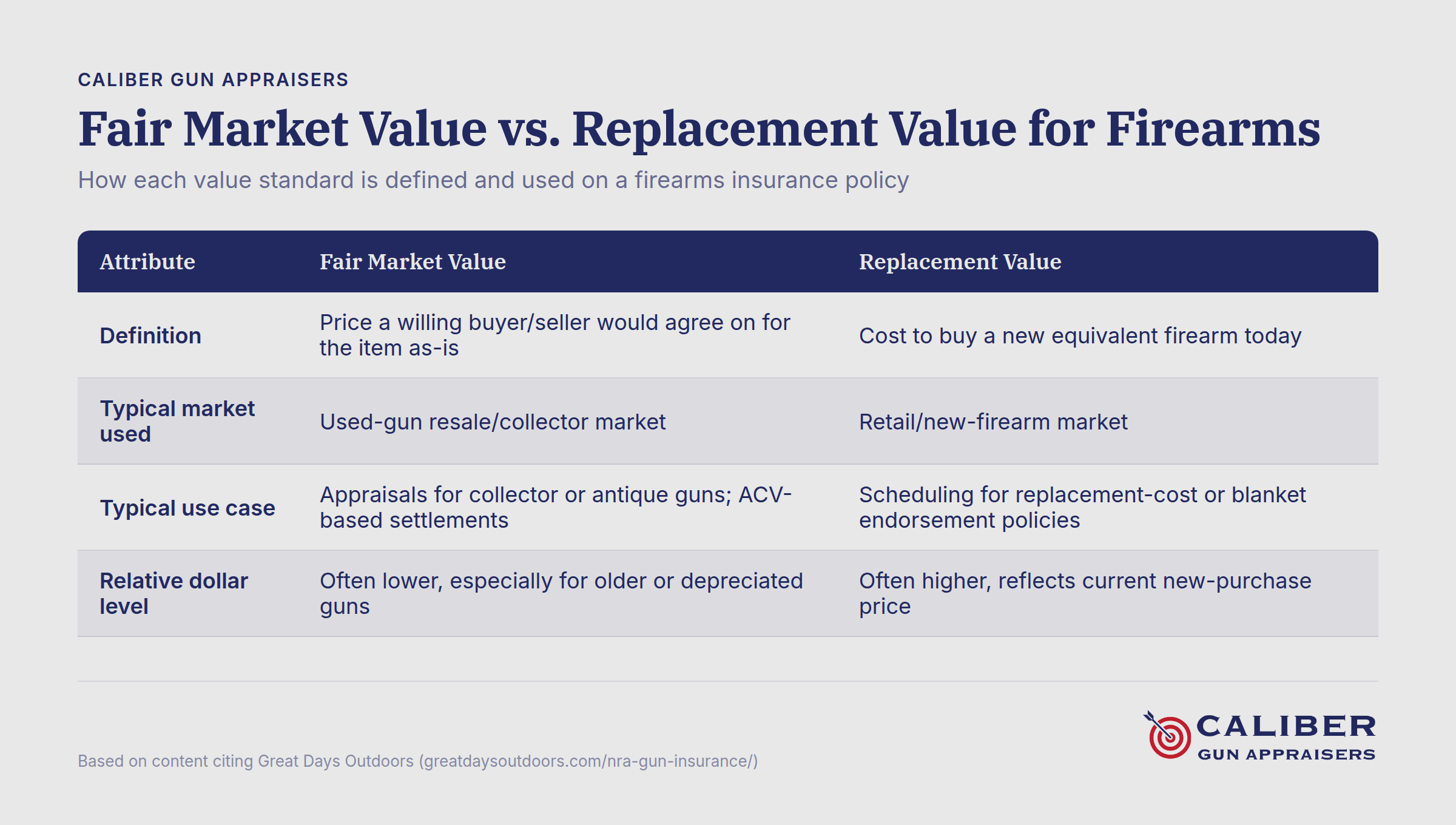
Fair Market Value vs Replacement Value at a Glance
The table below summarizes how the two standards differ in practice for firearm appraisals.
| Fair Market Value | Replacement Value | |
|---|---|---|
| Definition | Price a willing buyer pays a willing seller for the specific firearm in its actual condition | Cost to buy a new firearm of like kind and quality today, no depreciation deducted |
| Typical market used | Used-gun market: auction results, dealer transactions, private sales | Retail market: current MSRP or nearest current-production equivalent |
| Typical use | Estate settlement, donation, actual cash value insurance claims, equitable distribution | Insurance scheduling and replacement cost claims |
| Relative dollar level | Usually lower for common used firearms; can be higher than replacement for rare collectibles | Usually higher for discontinued or older common firearms; reflects today's retail pricing |
Worked Example: A Discontinued Rifle Under Both Standards
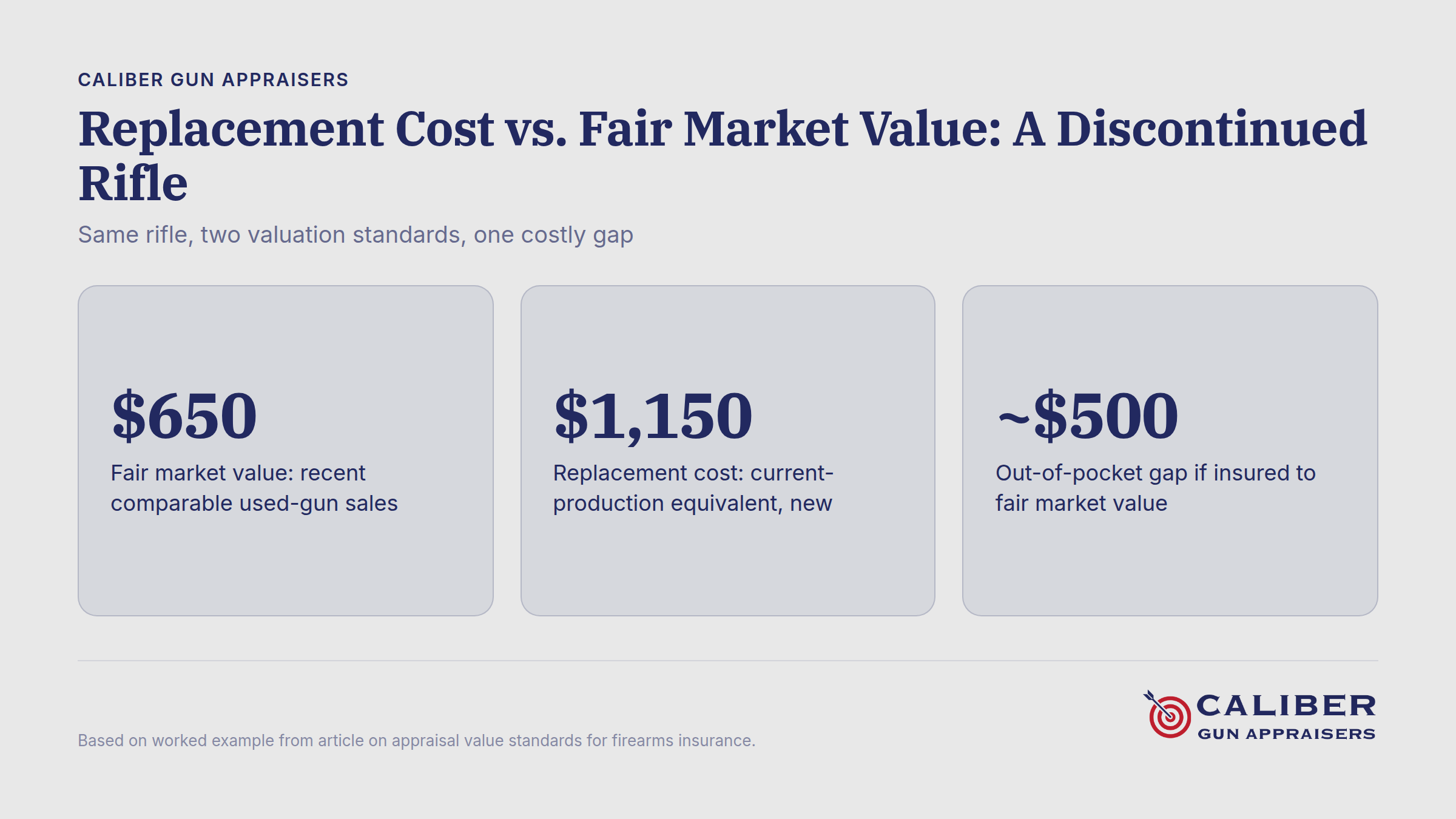
Example: A collector owns a bolt-action hunting rifle in a chambering the manufacturer discontinued about 15 years ago. The rifle is in good, well-cared-for condition but shows normal handling wear.
- Fair market value: Recent sales of comparable used rifles in this chambering and condition are running around $650. That figure reflects the actual used-gun market for this specific rifle, discounted for its age and condition.
- Replacement cost value: The manufacturer's closest current-production model in an available chambering retails for $1,150 today. That figure reflects what it would actually cost to walk into a shop and buy an equivalent new rifle right now.
If the appraisal was written to fair market value and the rifle is destroyed in a house fire, an ACV-based homeowners policy would likely pay somewhere close to that $650 figure, minus any applicable deductible. The collector would then need to come up with roughly $500 out of pocket to actually replace the rifle with a comparable new one. That $500 gap is what "underinsured" looks like in practice, and it's the direct result of an appraisal and a policy that weren't speaking the same value language.
Why the Appraisal Must State Which Value Standard Was Used
A credible firearm appraisal has to name its value standard on the report itself, not leave the reader to guess. Under recognized appraisal standards, the appraiser is required to identify the type and definition of value used for the assignment before presenting conclusions, because the same firearm can carry very different dollar figures depending on which standard is applied. This is a core requirement under the Uniform Standards of Professional Appraisal Practice (USPAP), which governs credentialed appraisal work across personal property, and it's echoed by the training and ethics standards of organizations including the ASA, ISA, and AAA.
Key takeaway: An appraisal that lists a dollar figure without naming whether it's fair market value or replacement value isn't incomplete by accident, it's incomplete in a way that can cost the owner real money at claim time.
When you request coverage-purpose appraisal work, tell the appraiser upfront that the report needs to support an insurance schedule, not an estate or donation filing. That single instruction determines whether the appraiser researches the used-collector market or the current retail market, and it's the difference between a report that protects you and one that quietly leaves you exposed.
Getting the Value Standard Right Before You Need It
The cleanest way to avoid this problem is to have a firearm appraised for insurance purposes before a loss, with the report explicitly stating that it was prepared to establish replacement value (or, if that's what the policy calls for, fair market value) for scheduling purposes. Fees for this work are quoted as a fixed amount once we've scoped the number of firearms, their condition, and the intended value standard, never billed by the hour.
If a loss has already happened and the insurer's settlement offer looks low, an independent appraisal that clearly documents the correct value standard is often the strongest tool a policyholder has in that negotiation. Whether you're insuring a collection for the first time or contesting a claim on one, our team can request an appraisal built around the exact value standard your situation calls for.
This article is provided for general informational purposes only and does not constitute legal, tax, or financial advice. Readers should consult a qualified attorney or insurance professional regarding their specific policy and circumstances.