
Blog
How NFA Firearm Transfers From an Estate to Heirs Actually Work
When a suppressor, short-barreled rifle, or machine gun sits in an estate, federal rules let the executor hold it through probate without triggering a taxable transfer, but heirs still need the right ATF paperwork before the item can change hands. This guide walks through the estate transfer rule, the Form 5 filing, required documentation, and why a documented date-of-death value matters for both ATF and IRS purposes.
When someone dies owning a suppressor, a short-barreled rifle, or a registered machine gun, the estate can't just pass that item to a family member the way it would a shotgun or a coin collection. NFA items (firearms and devices regulated under the National Firearms Act) carry their own registration and transfer requirements, and an estate has to follow a specific federal process before an heir can legally take possession. Our gun appraisal service for estate tax purposes exists largely because of this process: executors need a documented, defensible value for every NFA item before they can close out the estate paperwork correctly.
This is a narrower question than general gun trust planning, which we've covered separately in our guide to gun trusts and NFA ownership. That post is about structuring ownership before death. This one is about what happens after death, whether or not a trust was ever set up, when NFA items sit in a decedent's estate and need to move to a beneficiary.
What Counts as an NFA Item in an Estate?
The National Firearms Act covers a specific, limited category of items: suppressors, short-barreled rifles, short-barreled shotguns, machine guns, destructive devices, and the catch-all category known as "any other weapon." If the decedent's estate doesn't include one of these, the standard firearms transfer and appraisal process applies and none of the estate-specific rules below are relevant.
If it does include one, the item stays registered to the decedent in the National Firearms Registration and Transfer Record even after death. That registration doesn't disappear, and it doesn't automatically update to the heir's name. Someone in the estate has to file the correct paperwork with ATF before the item can legally leave the estate's control.
Can an Executor Legally Hold a Suppressor or Machine Gun During Probate?
Yes. Federal regulation lets an executor, administrator, personal representative, or other person authorized under state law to handle estate property possess a decedent's registered NFA firearm for the duration of probate without that possession counting as a taxable "transfer" under the NFA, according to ATF's published guidance on NFA firearms in decedents' estates.
That's the rule that keeps a probate process from becoming an accidental federal violation. Without it, an executor who takes a machine gun into a safe or an attorney's office while sorting out the estate could be committing an unregistered transfer. Instead, the estate can hold the item for as long as probate takes, so long as the executor doesn't hand it off to anyone else in the meantime.
Watch out: This possession exception only covers the executor named by the court or authorized under state law. It doesn't extend to a family member who simply takes the item home "until things get sorted out." That kind of informal handoff is exactly the transfer the rule is designed to prevent.
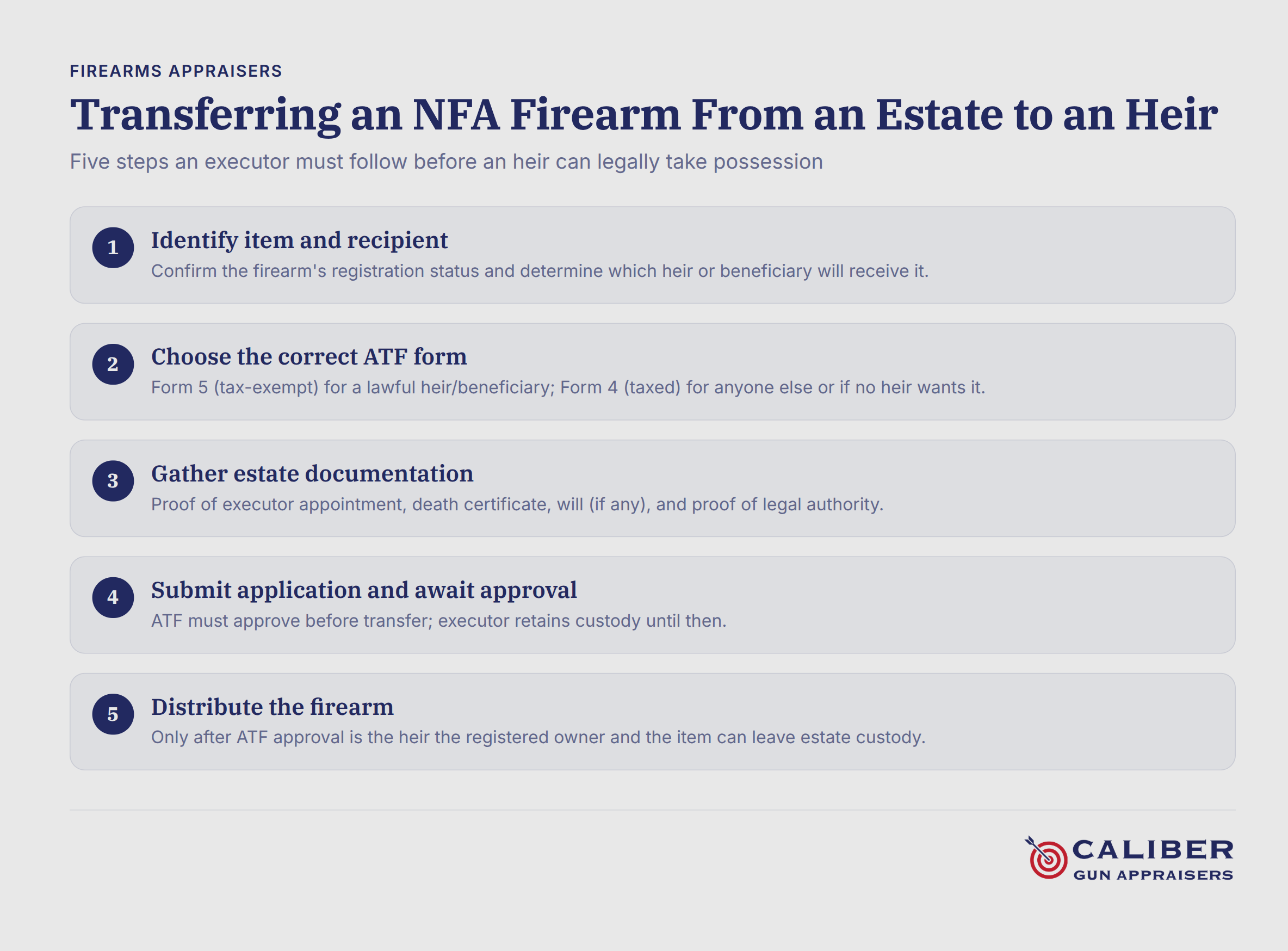
How the Estate-to-Heir Transfer Works Step by Step
No later than the close of probate, the executor has to file a transfer application with ATF. The path depends on who is receiving the item.
- Identify the registered item and the intended recipient. The executor confirms the firearm's registration status and identifies which named beneficiary or lawful heir will receive it, or whether it's going to someone outside the estate entirely.
- Choose the correct ATF form. A transfer to a beneficiary or lawful heir of the estate uses ATF Form 5, the application for tax-exempt transfer and registration. A transfer to anyone else, including a case where no heir wants the item, uses ATF Form 4, which carries the standard transfer tax.
- Gather the required estate documentation. ATF requires proof of the executor's appointment, a death certificate, a copy of the will if one exists, and any other document showing legal authority to dispose of the property.
- Submit the application and wait for approval. ATF must approve the transfer before the firearm changes hands. The executor keeps custody of the item until that approval comes through.
- Distribute the firearm once ATF approves. Only after approval is the heir the legally registered owner, and only then can the item leave the estate's custody.
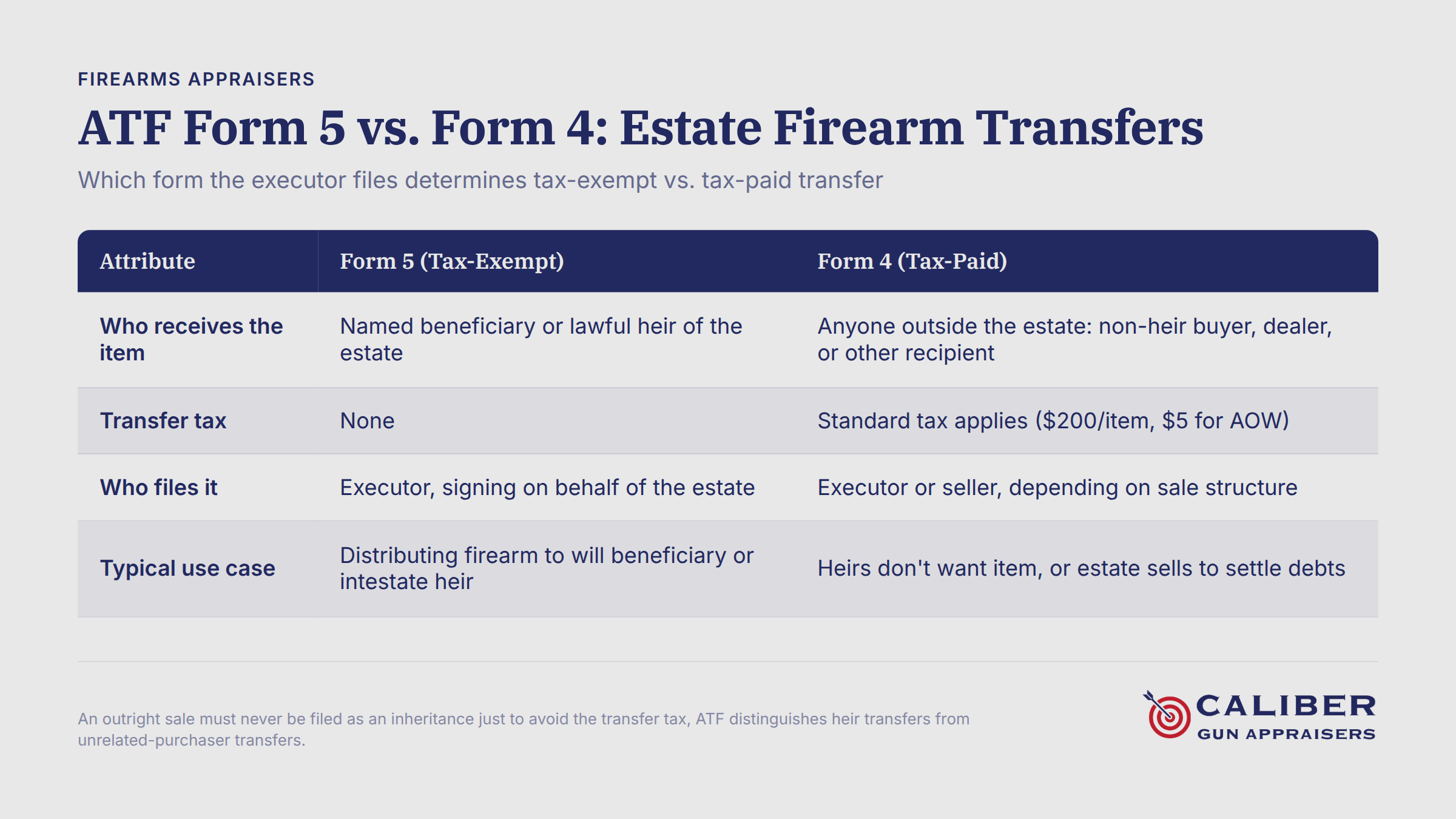
ATF Form 5 vs. Form 4: Which Applies to Your Estate?
The form the executor files determines whether the transfer is tax-exempt or subject to the standard transfer tax. Getting this wrong either creates unnecessary cost or an improperly documented transfer.
| Form 5 (Tax-Exempt) | Form 4 (Tax-Paid) | |
|---|---|---|
| Who receives the item | A named beneficiary or lawful heir of the estate | Anyone outside the estate: a non-heir buyer, dealer, or other recipient |
| Transfer tax | None | Standard transfer tax applies (commonly $200 per item, $5 for an "any other weapon") |
| Who files it | The executor, signing on behalf of the estate and identifying their title | The executor or seller, depending on how the sale is structured |
| Typical use case | Estate distributing the firearm to the person named in the will or entitled under intestate succession | The heirs don't want the item, or the estate sells it to settle debts or divide value |
An executor should never treat an outright sale as an inheritance simply to avoid the transfer tax. ATF distinguishes clearly between a transfer to a lawful heir and a transfer to an unrelated purchaser, and the paperwork has to match what's actually happening.
Documentation the Executor Must Submit With the Transfer Application
ATF's estate transfer rule requires specific supporting documents alongside the Form 5 or Form 4 application, according to ATF's estate transfer guidance. The executor should be ready to provide:
- Documentation establishing the executor's or administrator's appointment (letters testamentary or letters of administration from the probate court)
- A copy of the decedent's death certificate
- A copy of the will, if the decedent had one
- Any other evidence of the executor's legal authority to dispose of estate property
- Any additional document that affects how the firearms are being distributed from the estate
Incomplete documentation is one of the most common reasons an estate's Form 5 filing gets delayed. Courts issue letters testamentary at different points in the probate timeline depending on the state, so executors dealing with NFA items should request that paperwork early rather than waiting until the transfer application is otherwise ready.
Why the Estate Can't Hand the Firearm to a Dealer for Safekeeping
During probate, the executor has to maintain actual custody and control of the NFA item. Handing it to a third party, even temporarily and even to a licensed dealer for safekeeping or consignment, is itself a transfer under the NFA and defeats the purpose of the estate possession exception.
This catches families off guard more often than it should. An executor who isn't comfortable storing a machine gun or short-barreled rifle at home might assume a local dealer can hold it "just until the paperwork clears." That handoff is not covered by the estate exception and can create the exact registration violation the executor was trying to avoid.
Pro tip: If the executor genuinely can't securely store the item, the better move is to accelerate the ATF filing so the transfer to the rightful heir happens sooner, rather than introducing an unauthorized custodian in the meantime.
What Happens if the NFA Item Was Never Registered?
An unregistered NFA item found in an estate is contraband under federal law. The estate cannot register it after the fact, and the executor cannot simply file a Form 5 to fix a registration that never existed.
This situation isn't rare. Older suppressors, home-modified short-barreled firearms, or items a decedent believed were properly registered sometimes turn out not to be. When an executor discovers an item like this, the right move is to contact the local ATF field office directly about surrender, not to attempt a transfer, sell it, or pass it along to an heir. Attempting to move an unregistered NFA item, even within a family, carries serious legal exposure for everyone involved.
Why Fair Market Value Documentation Matters for the Form 5 and the Estate Tax Return
An accurate, documented fair market value as of the date of death supports both the ATF transfer paperwork and any federal estate tax filing the estate has to make. Fair market value for estate purposes is generally defined as the price at which the item would change hands between a willing buyer and a willing seller, neither one under compulsion to act, with both having reasonable knowledge of the relevant facts. Estates that are required to file IRS Form 706 can elect an alternate valuation date six months after death, but any item distributed, sold, or otherwise disposed of before that date has to be valued as of the disposition date instead. We've covered the mechanics of reporting firearms values on the estate tax return in more detail in our guide to Form 706 and firearms valuation.
A qualified appraisal for this purpose documents the make, model, and serial number of the item, its NFA registration status, its condition, and a supported value conclusion. That documentation does double duty: it backs up the executor's Form 5 filing and it supports the value reported on the estate tax return if one is required.
Our appraisers hold credentials with organizations such as the ASA, ISA, AAA, and CAGA, and every report we prepare follows recognized appraisal standards. For a standard firearm appraisal, our published pricing starts at $195, with an IRS-qualified appraisal (the version needed for estate tax filings) starting at $295; a typical single-item engagement runs $395 to $2,200 depending on rarity and documentation needs, with more complex collections priced higher. Every engagement is quoted as a fixed fee once we understand the scope, never billed by the hour.
Getting the Estate Transfer Right the First Time
An NFA item in an estate isn't complicated to transfer legally, but it does require doing things in a specific order: the executor holds the item under the estate exception, files the correct form before probate closes, submits the right supporting documents, and waits for ATF approval before the item moves to the heir. Skipping a step, using the wrong form, or handing the item to a third party in the meantime is where estates run into trouble.
If you're an executor sorting out a firearm collection that includes an NFA item, our team can prepare the documented, date-of-death valuation your Form 5 filing and estate tax return depend on. Request an appraisal and we'll scope the engagement based on what's in the estate.
This article is provided for general informational purposes only and does not constitute legal, tax, or financial advice. Executors should consult a qualified attorney familiar with NFA transfers and a CPA regarding the estate's specific tax filings.