
Blog
What Is a Gun Trust? NFA Ownership, Estate Planning, and Appraisal Basics
A gun trust lets multiple people lawfully possess suppressors, short-barreled rifles, and other NFA items, and it structures how those firearms pass to heirs. Here's how gun trusts work alongside ATF Rule 41F, and why a current, itemized firearms appraisal belongs in every trust you fund.
A gun trust, sometimes called an NFA trust or Title II trust, is a legal entity created under state trust law specifically to own firearms regulated by the National Firearms Act: suppressors, short-barreled rifles and shotguns, machine guns, destructive devices, and other Title II items. Collectors use one instead of registering NFA items in their own name because a trust changes who can lawfully touch the firearm, how it passes at death, and what paperwork the ATF requires along the way. If you're building or funding a gun trust, the appraisal step is easy to skip and expensive to get wrong later.
This guide covers what a gun trust actually does, how ATF Form 4 transfers and the 2016 responsible-person rule work, how a trust fits into a broader estate plan, and why a professional firearms appraisal belongs in the trust file from day one. We are not a law firm, and nothing here is legal advice on drafting a trust. For the trust document itself, talk to an attorney who handles NFA and estate matters in your state.
What Is a Gun Trust (NFA Trust)?
A gun trust is a revocable or irrevocable trust, drafted under state law, that holds title to firearms as trust property instead of holding them in an individual's name. Under ATF regulations, a trust is treated as a "legal entity," so the trust itself, not any single person, appears as the registered owner on the applicable ATF transfer forms.
That distinction matters because NFA firearms must stay registered to a specific owner in the National Firearms Registration and Transfer Record at all times. Possessing an NFA item that isn't properly registered to you, or to the trust that holds it, is a federal offense regardless of how the item ended up in your hands. A gun trust is built to keep that registration clean as ownership and access change over the years.
Collectors typically place suppressors, SBRs, SBSs, and machine guns into a gun trust, though many trusts also hold ordinary Title I firearms alongside the NFA items so the whole collection sits under one governing document. Our firearms appraisal services regularly support this kind of mixed collection, where a handful of registered NFA pieces sit next to dozens of standard rifles, shotguns, and handguns that all need to be scheduled and valued together.
Individual Ownership vs. Gun Trust Ownership
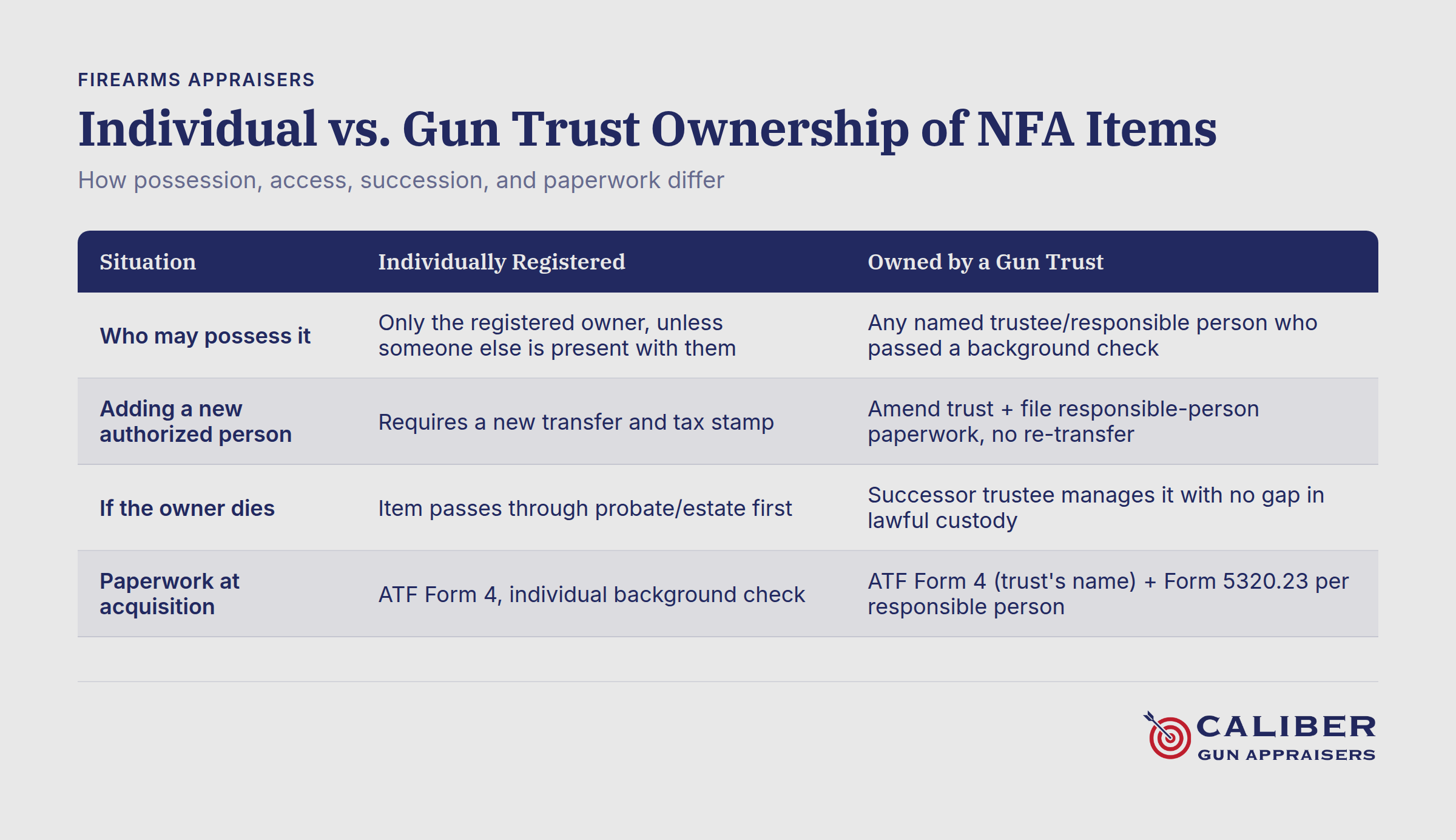
The practical differences show up most clearly when you compare how an individually registered NFA item behaves against one owned by a trust.
| Situation | Individually Registered NFA Item | NFA Item Owned by a Gun Trust |
|---|---|---|
| Who may lawfully possess it | Only the registered individual, unless someone else is physically present with them | Any trustee or responsible person named in the trust who has passed the required background check |
| Adding a new person with access | Requires a new transfer and tax stamp to add them as an owner | Often handled by amending the trust and completing the responsible-person paperwork, no re-transfer of the item itself |
| What happens if the owner dies | Item passes through probate or the estate before any transfer can occur | Successor trustee already named in the trust can manage the item without a gap in lawful custody |
| Paperwork at acquisition | ATF Form 4, individual background check | ATF Form 4 in the trust's name, plus Form 5320.23 for each responsible person |
ATF Form 4 Transfers and the Rule 41F Responsible-Person Requirement
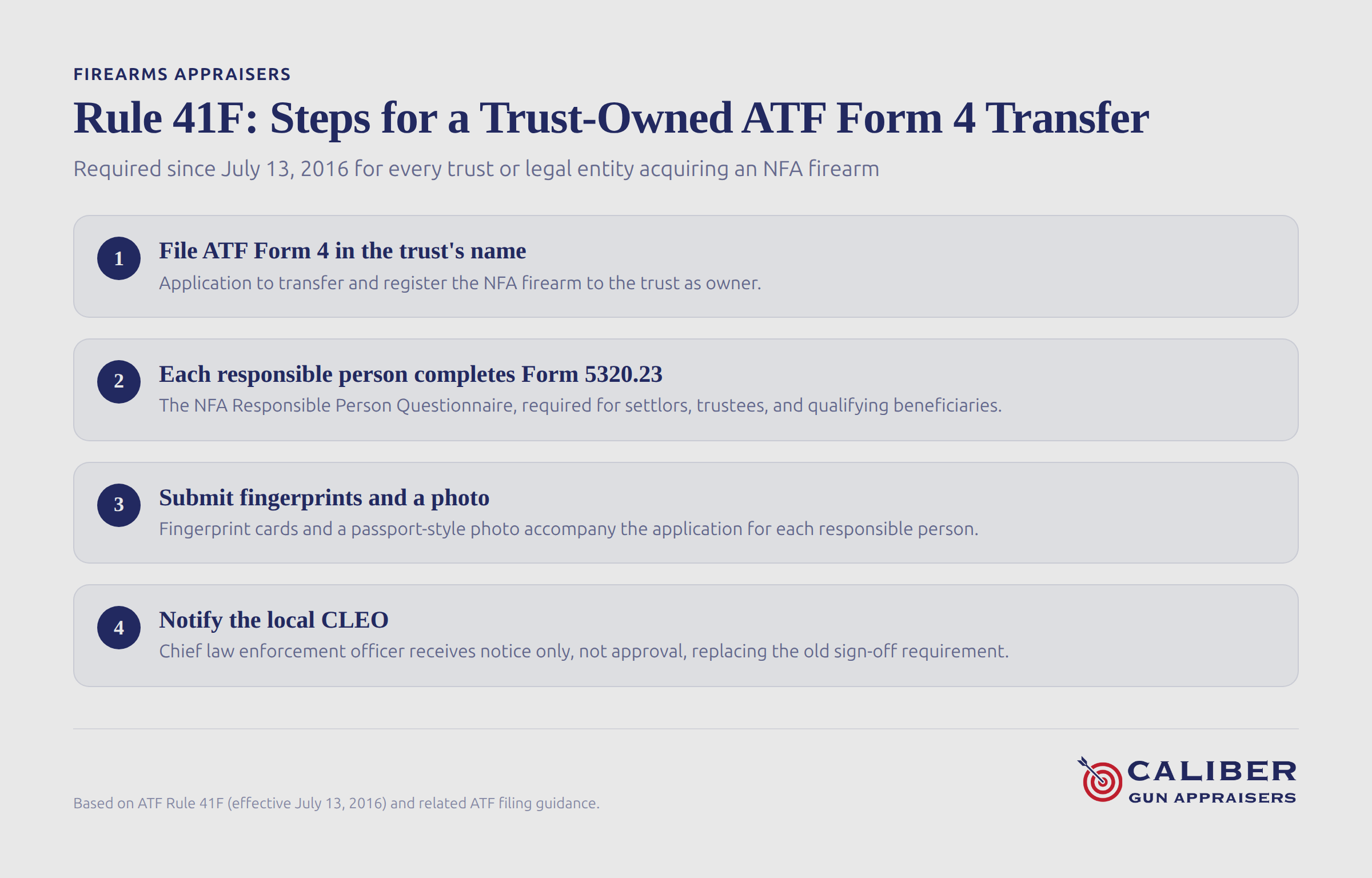
Every transfer of a Title II firearm to a trust still runs through ATF Form 4, the application to transfer and register an NFA firearm. What changed in 2016 is who else has to clear a background check before that transfer is approved.
The ATF's Rule 41F, formally Machineguns, Destructive Devices and Certain Other Firearms; Background Checks for Responsible Persons of a Trust or Legal Entity, took effect on July 13, 2016, and it applies to every trust or legal entity making or receiving an NFA firearm, not just individual applicants. The rule was written to close a gap where a trust could hold an NFA item while the people actually controlling it never underwent a background check the way an individual applicant always had, according to the ATF's final rule summary.
A "responsible person" under 41F is anyone with the power to direct the trust's management and policies as they relate to firearms, which usually includes settlors, trustees, and co-trustees, and sometimes beneficiaries if the trust document gives them that kind of authority, per guidance on who qualifies as a responsible person.
For every trust-owned Form 1, Form 4, or Form 5 filing, each responsible person must now:
- Complete ATF Form 5320.23, the National Firearms Act Responsible Person Questionnaire.
- Submit fingerprint cards and a passport-style photograph with the application, a documentation requirement laid out in ATF-related filing guidance on the 41F process.
- Notify the chief law enforcement officer of their jurisdiction, a step that replaced the old CLEO sign-off requirement with simple notice instead of approval.
Pro tip: Rule 41F removed the CLEO approval hurdle that used to trip up individual buyers, but it also means adding a new trustee to an existing gun trust now triggers the same fingerprint-and-photo process as a brand-new applicant. Budget time for that step before you assume a new trustee can immediately handle an NFA item.
How a Gun Trust Fits Into Estate Planning
A gun trust earns its keep at two moments: while the collector is alive and wants to share lawful access with family or friends, and after the collector dies, when the collection has to move to someone else without a lapse in legal registration.
Because the trust, not the individual, is the registered owner, a well-drafted trust names successor trustees who step into management automatically on the settlor's death or incapacity. That structure avoids one of the most common and dangerous mistakes families make with inherited NFA items: moving a suppressor or short-barreled rifle before anyone has confirmed who is legally allowed to possess it.
Estate practitioners who handle firearms specifically warn that if an estate or trust holds NFA items, they should not be removed from the premises until the personal representative or trustee has located the Form 4 and confirmed their own legal authority over the property, since the item must remain registered to a lawful owner at every point in the chain, as detailed in state bar guidance on handling firearms in an estate. An unregistered transfer, even an accidental one between grieving family members, is a federal violation.
Even with Rule 41F's added paperwork, a gun trust still gives collectors real planning advantages that an individual registration cannot:
- Named beneficiaries receive clear instructions, so heirs don't have to guess who gets which firearm or negotiate among themselves after the fact.
- Successor trustees can act immediately, without waiting on probate to determine who has authority over the collection.
- Mixed collections stay under one document, so NFA items and ordinary firearms transfer under the same set of instructions instead of splitting into separate legal processes.
Legal commentators who work in this space note that these succession and shared-access benefits are exactly why gun trusts remain popular even after Rule 41F added background checks that didn't exist before, according to analysis on whether trusts are still worthwhile post-41F. The rule changed the paperwork, not the underlying reason collectors set up trusts in the first place.
Our gun appraisal service for estate tax purposes works alongside this planning by giving the trustee and the estate's attorney or CPA a documented fair market value for every item the trust holds, so nothing gets guessed at when it's time to file.
Why a Professional Firearms Appraisal Matters When You Fund a Gun Trust
A gun trust needs an accurate value for what it holds, and that value should come from a qualified appraiser, not a rough guess based on online listings. Funding the trust, whether with a single suppressor or an entire collection, means someone has to put a defensible number on paper.
An itemized, current appraisal supports three things a trustee actually needs:
- A schedule of assets for the trust document. The trust needs a clear inventory of what it owns, tied to serial numbers and descriptions, not a vague reference to "the firearms collection."
- Adequate insurance coverage. Insurers generally want an appraised value or a detailed schedule before they'll cover a high-value collection, and an outdated estimate can leave a trust underinsured on its most valuable NFA pieces.
- A defensible baseline for eventual estate settlement. When the collection eventually transfers to heirs or gets divided among beneficiaries, a documented value prevents disputes over who got more or less.
Firearms appraisals prepared for a trust or estate should be done in accordance with the Uniform Standards of Professional Appraisal Practice (USPAP) by appraisers holding credentials from organizations such as the Certified Appraisers Guild of America (CAGA) or the American Society of Appraisers (ASA), consistent with standards published by The Appraisal Foundation. That framework matters because a trustee's valuation may eventually be reviewed by an insurer, a probate court, or the family itself, and a report built to a recognized standard holds up to that scrutiny far better than a dealer's verbal estimate.
Our team follows this documentation approach when we inventory and appraise an inherited gun collection: serial numbers, condition notes, provenance where available, and photographs for every item, NFA and non-NFA alike.
Watch out: A single lump-sum estimate for "the collection" isn't useful to a trustee. If a beneficiary later contests how the estate divided the firearms, an itemized report with individual values for each piece is what actually resolves the disagreement.
Engagements are quoted as a fixed fee after we scope the collection, never billed hourly. Fees are driven by the size and complexity of the collection and whether the report needs to be IRS-qualified for estate or gift tax filing, not by the value of any individual firearm. A standard firearms appraisal typically starts around $195, an IRS-qualified report starts around $295, and a full collection with rare or unusual NFA pieces can run from roughly $1,600 to $3,500 or more depending on the number of items and the depth of research each one requires.
Get Your Collection Appraised Before You Fund the Trust
A gun trust solves the legal side of shared possession and succession. It does not solve the valuation side, and that's where most trustees end up improvising. Before you transfer a suppressor, an SBR, or a full collection into a trust, get a written appraisal that documents what each item is actually worth.
Request a firearms appraisal from our team to get an itemized, USPAP-compliant report you can attach directly to your trust's schedule of assets, whether you're funding a new trust or updating an existing one for an estate plan.
This article is provided for general informational purposes only and does not constitute legal, tax, or financial advice. Gun trust formation involves state trust law and federal firearms regulations that vary by jurisdiction and circumstance. Readers should consult a qualified attorney who handles NFA and estate matters, along with a CPA where tax filings are involved, regarding their specific situation.