
Blog
Donating a Gun Collection for a Tax Deduction? Here's How the IRS Appraisal Works
Donating a gun collection can produce a real tax deduction, but the IRS requires a qualified appraisal once the collection's value crosses $5,000. Here's how fair market value, Form 8283, and the aggregation rule for firearms actually work.
Donating a firearm collection to a qualified charity can produce a genuine tax deduction, but the IRS treats guns exactly like any other noncash property: the deduction rides on documented fair market value, not sentiment or what you paid decades ago. Miss a signature, misdate the appraisal, or lean on a dealer's buyback quote instead of a real valuation, and the IRS can disallow the deduction outright. This guide walks through the fair-market-value standard, the dollar thresholds that trigger a qualified appraisal, and the Form 8283 mechanics specific to a firearms collection.
What "Fair Market Value" Means for a Donated Firearm Collection
For charitable-donation purposes, the IRS defines fair market value as the price a willing, knowledgeable buyer would pay a willing, knowledgeable seller, with neither party under pressure to buy or sell. This standard comes from federal regulations governing charitable contribution deductions and is elaborated in IRS Publication 561, which sets out how donated property of every kind, including collectibles, should be valued.
For a firearm collection, that means value is driven by condition, rarity, matching serial numbers and original parts, provenance, and what comparable guns have actually sold for between informed collectors, not what a pawn shop would pay wholesale or what a similar model cost new. Sentimental value or family history has no bearing on fair market value unless it demonstrably affects what a buyer would pay. If you inherited a collection and are still cataloging what you own before deciding what to donate, our guide on inventorying and appraising an inherited gun collection walks through that groundwork step by step.
When Does the IRS Require a Qualified Appraisal for a Gun Collection?
A qualified appraisal becomes legally required once a single firearm, or a group of similar firearms donated in the same year, is valued at more than $5,000. This threshold comes from the tax code's charitable contribution substantiation rules and the Treasury regulations governing donated property appraisals, and it applies whether the $5,000 is reached by one rare rifle or by several ordinary guns added together.
Below that $5,000 line, you can generally support the deduction with your own documentation and Form 8283's Section A. Above it, the appraisal must be prepared by a qualified, independent appraiser, and the mechanics of your paperwork change substantially. If you're not sure which side of that line your collection falls on, it's worth requesting a firearms appraisal before you file rather than guessing at a value and hoping it holds up.
The Dollar Thresholds That Control Your Paperwork
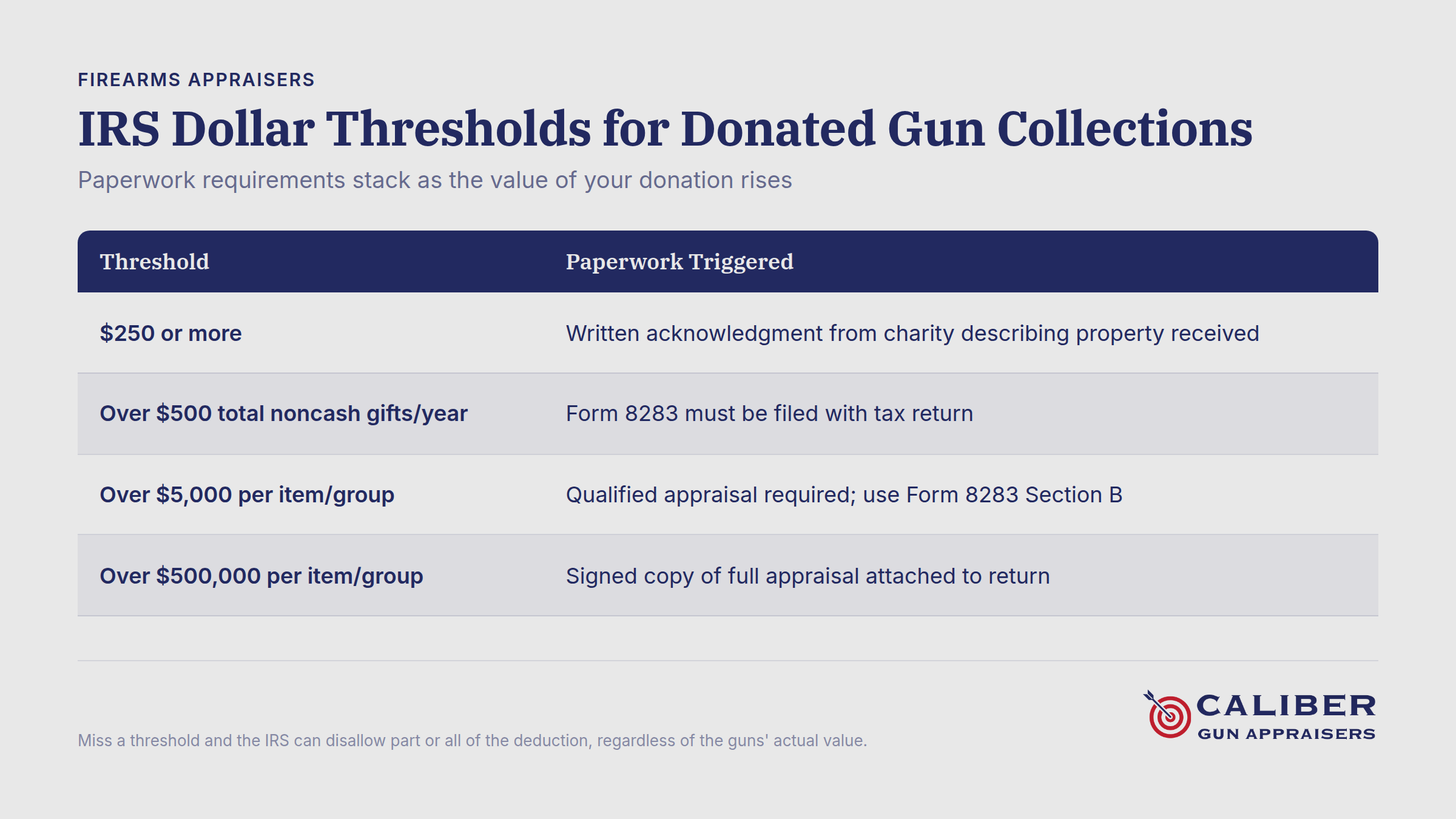
Four separate dollar amounts determine what the IRS expects from you, and they stack on top of each other as the value of the donated collection rises.
| Threshold | What It Triggers |
|---|---|
| $250 or more | A contemporaneous written acknowledgment from the charity, describing the property and stating whether you received anything in return |
| Over $500 in total noncash contributions for the year | Form 8283 must be filed with your tax return |
| Over $5,000 per item or group of similar items | A qualified appraisal is required, and you complete Form 8283 Section B instead of Section A |
| Over $500,000 per item or group of similar items | A complete, signed copy of the qualified appraisal itself must be attached to the return |
Miss any one of these and the IRS has clear grounds to disallow part or all of the deduction, even if the underlying value of the guns was never in dispute.
The "Group of Similar Items" Rule: Why Multiple Rifles Get Aggregated
The IRS does not let a collector split a valuable collection into smaller pieces to dodge the appraisal requirement. Firearms donated in the same tax year that fall into the same general category are treated as a "group of similar items" and their values are added together for purposes of the $5,000 and $500,000 thresholds, according to the Form 8283 instructions.
Example: You donate 3 vintage bolt-action rifles to a museum, each independently worth $2,500. No single rifle crosses $5,000, but because they're similar property donated in the same year, the IRS aggregates them into a combined $7,500. That total crosses the $5,000 threshold, so a qualified appraisal and Form 8283 Section B apply to the whole group, not just the priciest rifle in it.
Watch out: This rule catches collectors who assume each gun is evaluated in isolation. If your collection includes several firearms of the same general type, run the math on the group total before deciding you can skip the appraisal.
Form 8283 Section A vs Section B: What Changes at $5,000
Section A covers noncash donations of more than $500 but not more than $5,000. It asks for a description of the firearms, when and how you acquired them, your cost basis, the fair market value, and the valuation method used, and it does not require an appraisal.
Section B applies once the item or group exceeds $5,000, and it adds real mechanical requirements on top of the same description and basis information found in Section A:
- Part III (Declaration of Appraiser): the qualified appraiser signs and dates a declaration confirming their qualifications and the appraisal they performed.
- Part V (Donee Acknowledgment): the receiving charity signs to confirm it received the described property, which the IRS's guidance on substantiating noncash contributions treats as a required part of a complete filing.
A Form 8283 with the donee section left blank is an incomplete filing. Charities that regularly accept property donations are used to signing this section, so ask before you assume it's a formality.
What Happens at $500,000: Attaching the Full Appraisal
Most firearm collection donations never approach this level, but for a museum-grade or historically significant collection, crossing $500,000 in claimed value means Form 8283 alone isn't enough. A complete, signed copy of the qualified appraisal report itself must be attached to the tax return, not just referenced or summarized. Below this threshold, you keep the appraisal in your own records and produce it only if the IRS asks.
Common Documentation Mistakes That Sink a Firearms Appraisal Deduction
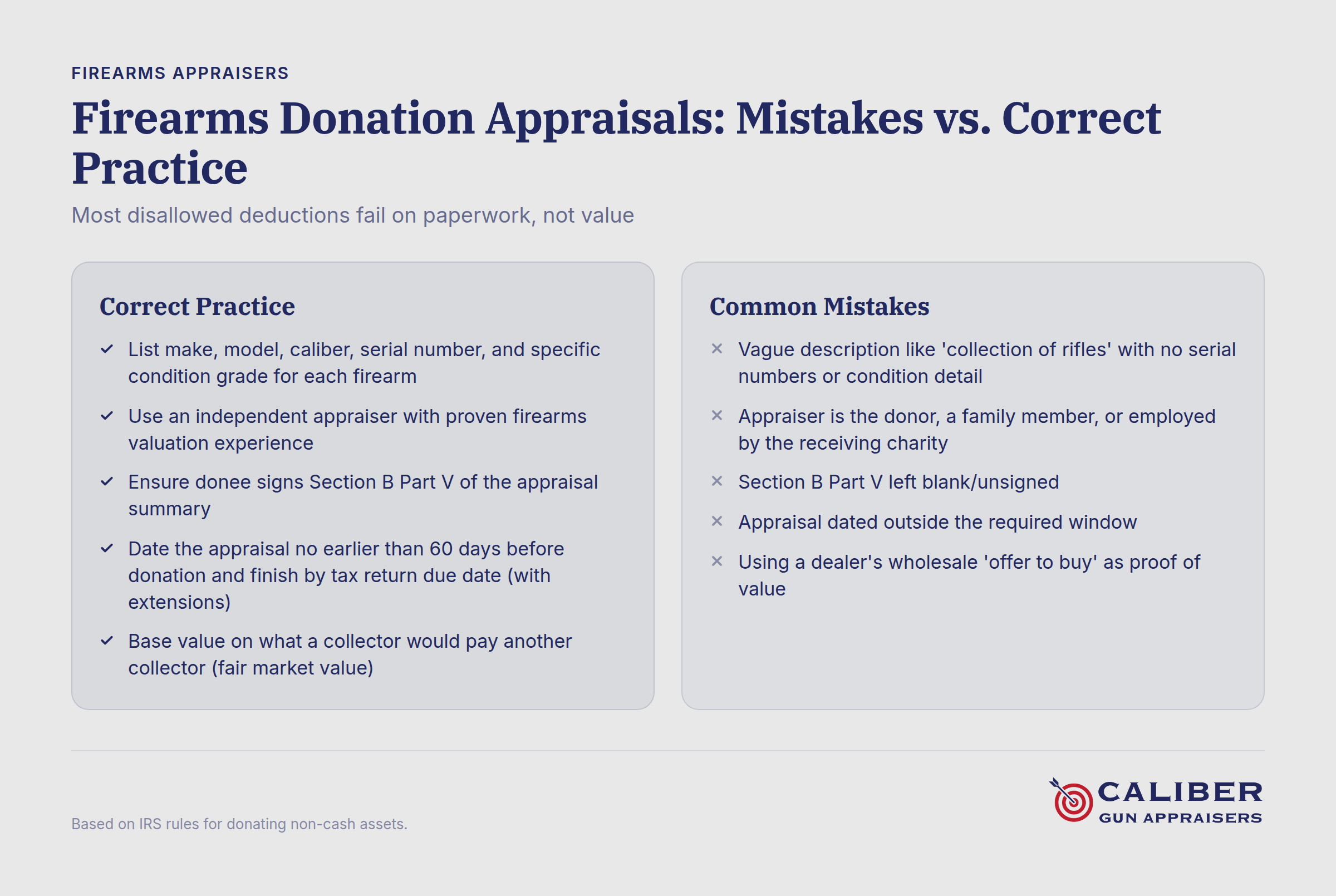
Most disallowed firearm-collection deductions fail on paperwork, not on the underlying value. The IRS's rules for donating non-cash assets get enforced strictly, and these are the errors that show up most often:
- Missing serial numbers and condition detail: a description like "collection of rifles" gives the IRS nothing to verify. Every firearm needs make, model, caliber, serial number, and a specific condition grade.
- An appraiser who isn't qualified or independent: the appraiser cannot be the donor, a family member, or someone employed by the receiving charity, and they need demonstrable experience valuing firearms specifically.
- A blank donee acknowledgment: Section B Part V left unsigned makes the appraisal summary incomplete even if everything else is correct.
- An appraisal dated outside the required window: a qualified appraisal must be made no earlier than 60 days before the date of the donation and completed by the tax return's due date, including extensions.
- Using a dealer's "offer to buy" as proof of value: a buyback quote reflects what a dealer will pay wholesale before reselling at a markup. It is not evidence of the price a collector would pay another collector, which is the fair market value standard the IRS actually applies.
What a Qualified Firearms Appraisal Report Should Include
A defensible appraisal for a donated gun collection documents far more than a single dollar figure. It should include a detailed description of each firearm (make, model, caliber, year of manufacture, and serial number), a condition assessment, notes on provenance or historical significance, the comparable sales data used to support the conclusion, the valuation method applied, and the appraiser's qualifications and signed declaration.
Firearms appraisers commonly hold credentials with organizations such as the ISA, ASA, and AAA, and a report prepared for an IRS filing should be built in accordance with USPAP, the Uniform Standards of Professional Appraisal Practice. Fees for this type of engagement are quoted as a fixed amount after scoping the collection, never billed hourly. AIN's standard firearms appraisal starts at $195, an IRS-qualified appraisal suitable for a charitable donation deduction starts at $295, and most gun and firearm appraisals fall between $395 and $2,200 depending on the number of items and the depth of research required, with especially large or historically complex collections running from $1,600 to $3,500 or more. Readers weighing the cost against the size of a collection can see more detail in our firearm appraisal pricing FAQ.
File With Confidence Before You Donate
A gun collection donation can be a straightforward deduction or a paperwork problem, and the difference usually comes down to whether the valuation and the forms were handled correctly from the start. Know your collection's aggregate value, confirm which side of the $5,000 line it falls on, and line up a qualified appraiser well before your filing deadline so the 60-day window doesn't work against you.
If you're planning a charitable donation of firearms and need a qualified appraisal that will hold up to IRS review, request an appraisal from our team before you file.
This article is provided for general informational purposes only and does not constitute legal, tax, or financial advice. Readers should consult a qualified attorney or CPA regarding their specific circumstances.