
Blog
Gun Auction Sold Prices vs Asking Price: Reading Firearm Value Data Right
Asking prices on gun listings are aspirational and skewed upward by inventory that never sells. This guide shows how to read GunBroker completed listings and auction house realized prices so your fair market value opinion rests on actual sold prices, not wishful ones.
When someone asks what their firearm is worth, the first instinct is often to search active listings and take the highest number they find. That number is almost always wrong, and not by a small margin. Understanding gun auction sold prices vs asking price is the single most important skill in reading firearm value data correctly, because only one of those two figures reflects what buyers actually pay.
Why Fair Market Value Requires a Completed Transaction
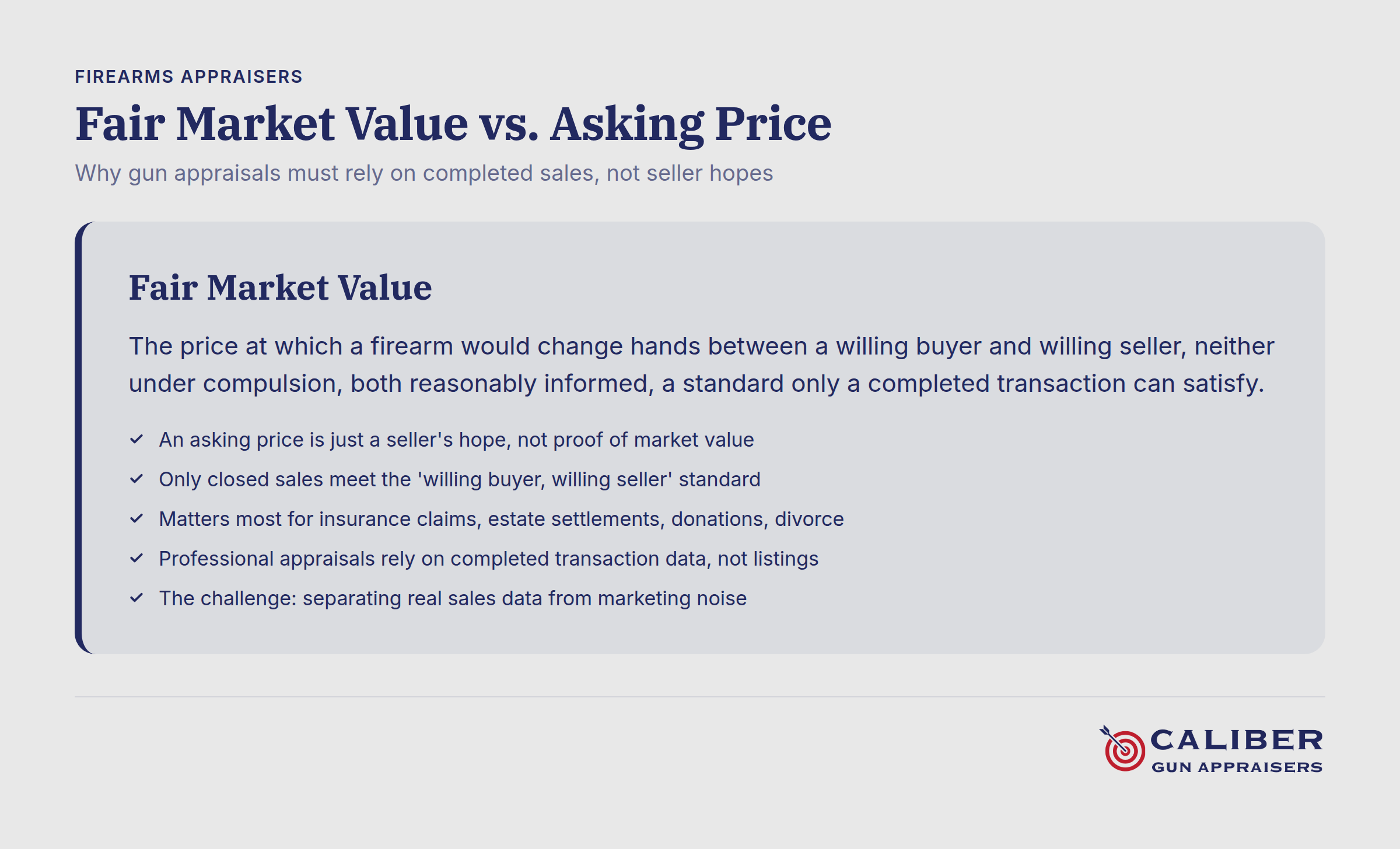
Fair market value is the price at which a firearm would change hands between a willing buyer and a willing seller, neither one under any compulsion to act, and both reasonably informed about the item and the market for it. That definition only describes a transaction that has actually closed. An asking price describes a seller's hope. Until a buyer agrees to pay it, it tells you nothing about what the market will actually bear.
This distinction matters most when the appraisal has to hold up to scrutiny: an insurance claim, an estate settlement, a donation deduction, or a divorce property division. Our gun appraisal service builds every value opinion around completed sales because that is the only data that satisfies the willing buyer, willing seller standard appraisers are required to use. Anyone trying to answer how much their gun is worth on their own runs into the same problem professionals train for years to solve: separating real transaction data from marketing noise.
The Specific Ways Asking Prices Mislead
Active listings are biased upward for reasons that have nothing to do with a firearm's true market value. Several factors compound to inflate the numbers a casual searcher sees.
- Selection bias from unsold inventory. A listing that has been sitting for 6 months at $3,200 is still visible and still counted if you average "what's out there." It is sitting at that price precisely because nobody has paid it. Every day it stays unsold is evidence against the price, not for it.
- Dealer markup and overhead. A gun shop's asking price bakes in rent, insurance, staff wages, and profit margin on top of what the shop itself paid. That markup is a legitimate cost of doing business, but it is not part of the firearm's fair market value between private parties.
- Condition and configuration mismatches. A pristine, unfired example in the original box is not comparable to a well-used field gun with a replaced stock, even if both are the same model and caliber. Asking prices for the nicest examples get quoted as if they represent the whole population.
- No bid count or reserve context. An asking price carries no signal about buyer interest. A completed auction with 14 bidders and a met reserve tells you demand was real. A listing with a "make offer" button tells you nothing.
- Static, lagging prices. Asking prices can sit unchanged for months while the actual market moves. A price guide or classified ad written 18 months ago may no longer reflect current demand, especially for firearms tied to political or cultural cycles that shift buying interest quickly.
Watch out: A single eye-catching asking price, especially one described as a "steal" or "rare find," is the least reliable data point available. Treat it as an outlier until a comparable completed sale confirms it.
How to Read GunBroker Completed Listings Correctly
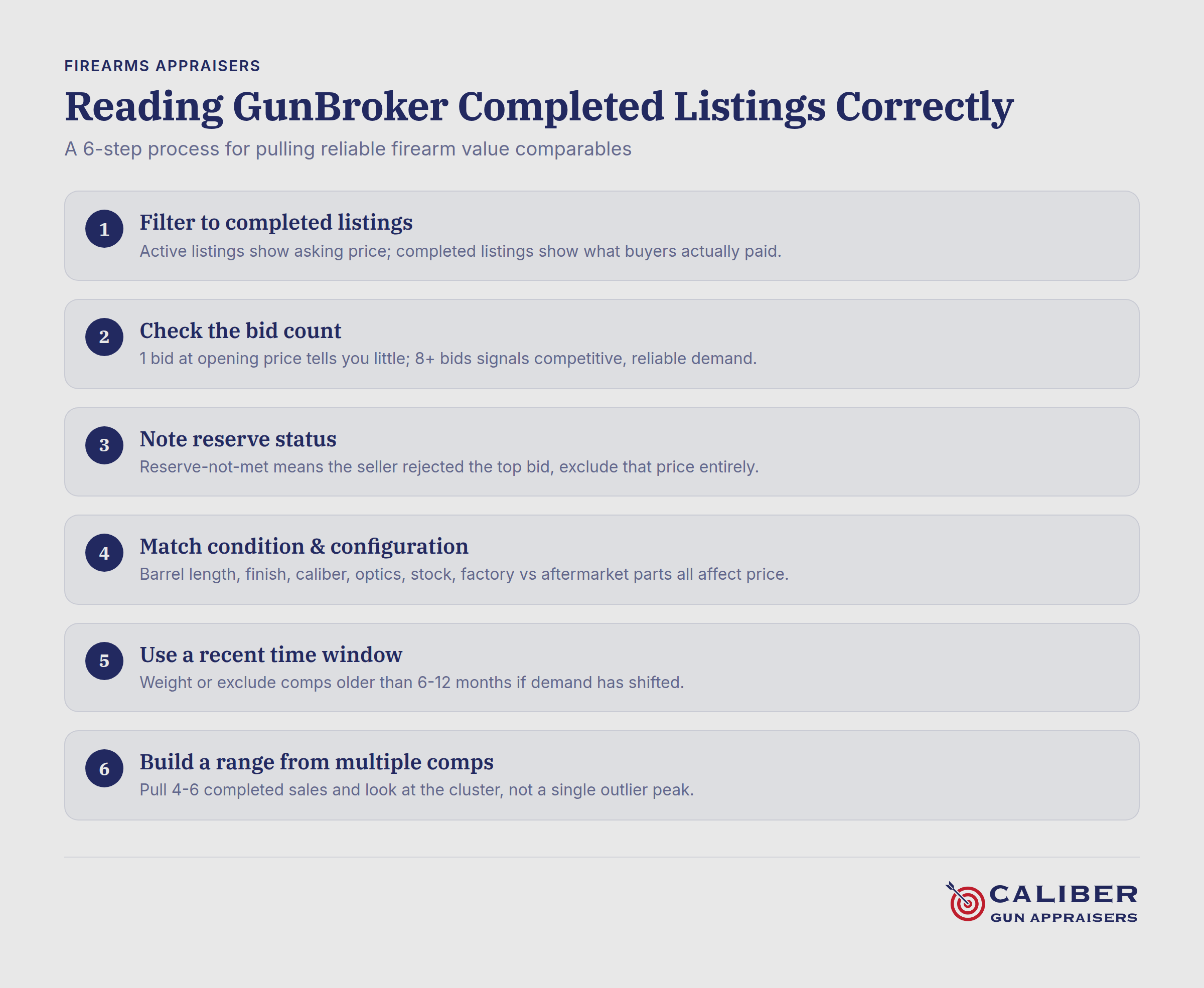
Completed listings are the closest thing the retail firearms market has to a public sales record, but reading them takes more than sorting by price. Follow a consistent process so the comparables you pull actually represent the market.
- Filter to completed, not active, listings. Active listings show asking prices. Completed listings show what buyers actually agreed to pay, which is the only figure that belongs in a fair market value opinion.
- Check the bid count. A completed listing with 1 bid at the opening price tells you almost nothing about demand. A listing with 8 or more bids suggests competitive interest and a more reliable price.
- Note whether the reserve was met. A reserve-not-met result means the seller rejected the highest bid. That price point should be excluded from your comparable set entirely.
- Match condition grade and configuration. Barrel length, finish, caliber, optics, stock material, and factory versus aftermarket parts all move price. A comp only counts if the gun in front of you matches closely on these points.
- Use a recent time window. Firearm demand shifts with ammunition availability, legislation, and broader market sentiment. Comps older than 6 to 12 months should be weighted less, or excluded if the market has moved noticeably since.
- Build a range from multiple comps, not one outlier. A single high sale could reflect a bidding war between two motivated buyers, which is not representative of what the item most commonly sells for. Pull 4 to 6 completed sales and look at the cluster, not the peak.
How Auction House Realized Prices Work
Auction house results use a different structure than online marketplace sales, and appraisers have to know which figure they are looking at. The hammer price is the winning bid amount, the point at which the auctioneer's gavel falls. The buyer's premium is an additional fee, commonly in the 15% to 25% range, added on top of the hammer price and paid by the buyer to the auction house.
Some published auction results list only the hammer price, while others report the "price realized," which includes the buyer's premium. Confusing the two can distort a comparable set: a $4,000 hammer price with a 20% premium becomes a $4,800 total transaction cost to the buyer, which is the more accurate figure for market value purposes since it reflects the full amount an informed buyer was willing to pay to acquire the piece.
Auction house data has an advantage over general marketplace listings: catalog descriptions from established firearms auction houses tend to be more detailed and more consistently graded, which makes condition matching easier. It also has a limitation: fewer transactions happen through specialty auction houses than through high-volume online platforms, so the sample size for any given model may be thinner.
A Worked Example: Asking Price vs a Real Comp Set
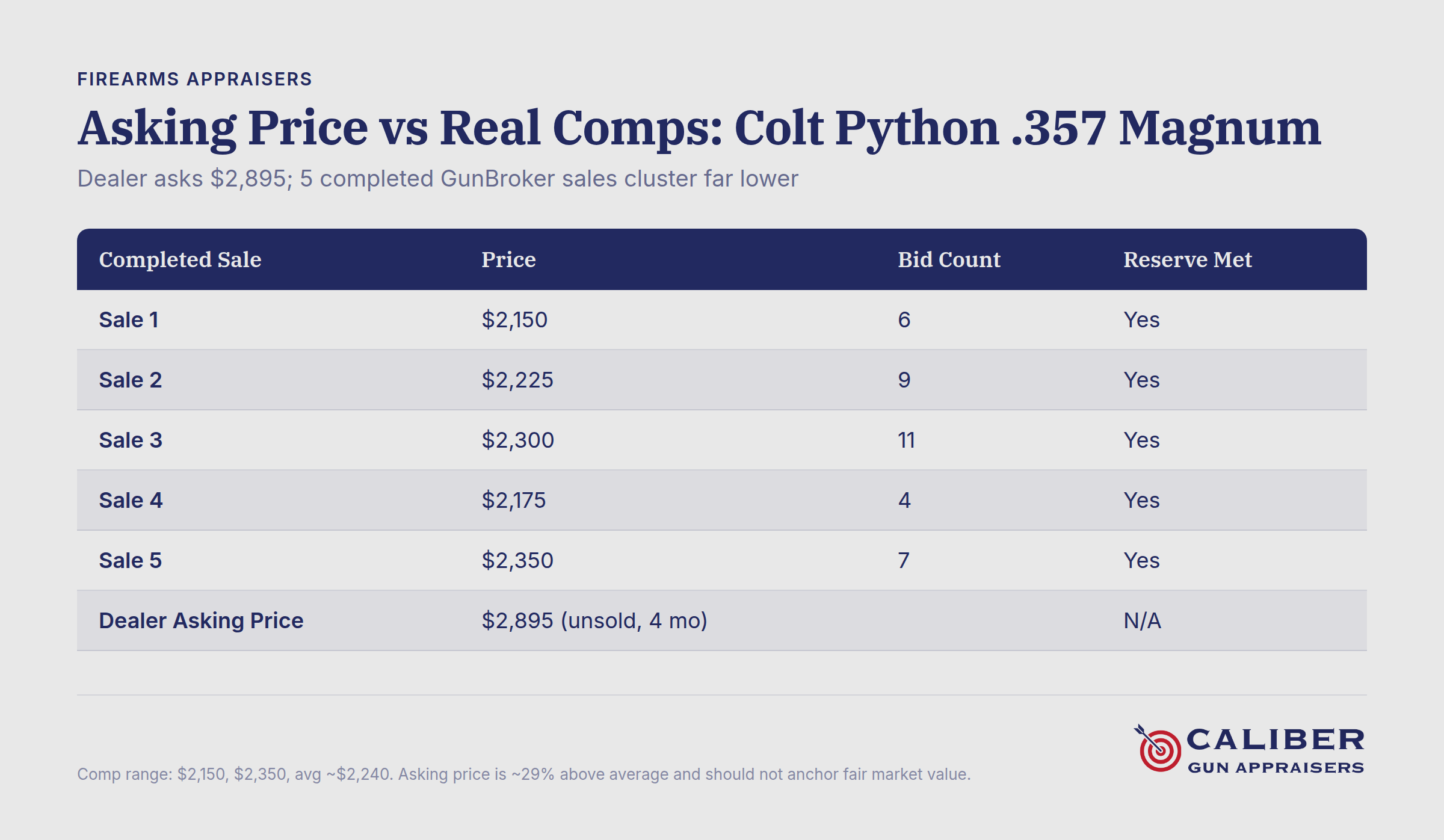
Consider a Colt Python .357 Magnum with a 4-inch barrel and factory nickel finish, in excellent condition with original box and papers. A dealer's asking price online is listed at $2,895, and it has been posted for 4 months without selling.
Pulling 5 completed GunBroker listings for the same model, barrel length, finish, and condition grade over the past 90 days produces this cluster:
| Completed Sale | Price | Bid Count | Reserve Met |
|---|---|---|---|
| Sale 1 | $2,150 | 6 | Yes |
| Sale 2 | $2,225 | 9 | Yes |
| Sale 3 | $2,300 | 11 | Yes |
| Sale 4 | $2,175 | 4 | Yes |
| Sale 5 | $2,350 | 7 | Yes |
The cluster sits between $2,150 and $2,350, with an average of roughly $2,240. The dealer's $2,895 asking price sits well above every completed sale in the comp set, roughly 29% higher than the average. That gap is not evidence the gun is worth more; it is evidence the dealer has priced above what buyers in this market have actually agreed to pay for a matching example. An appraiser building a fair market value opinion would anchor to the $2,150 to $2,350 range supported by the completed sales, not to the outstanding asking price.
Building a Defensible Value Opinion
Reading gun value data correctly comes down to one habit: always ask whether a price represents a transaction that actually happened. Asking prices, dealer markups, and stale price guides all describe what someone hopes to receive. Completed GunBroker sales and auction house realized prices describe what a buyer and seller actually agreed to. Only the second category belongs in a fair market value opinion, and only a comp set built from several matching, recent, reserve-met sales gives that opinion the support it needs to withstand review by an insurer, the IRS, or a court.
Our appraisers hold credentials with organizations including the ISA, ASA, and AAA, and every firearm valuation we prepare is built around verified completed transactions rather than aspirational listings. If you need a defensible, USPAP-compliant value opinion for insurance, estate, probate, or donation purposes, request an appraisal and our team will build the comp set correctly the first time.