
Blog
How to Report Firearms Valuation on IRS Form 706 for Estate Tax
Firearms valuation on Form 706 hinges on a $3,000 threshold that most executors miss until it's too late. This guide walks through fair market value at the date of death, when a written appraisal becomes mandatory, and how the alternate valuation election can change what the estate owes.
When someone who collected firearms passes away, those guns become part of the taxable estate just like any other personal property. Executors filing Form 706 need to know exactly how firearms get valued, when a formal appraisal becomes legally necessary, and how a missed deadline or a sloppy valuation can cost heirs real money. This guide walks through the mechanics step by step, using a worked example to show where the numbers actually land.
Our gun appraisal service for estate tax purposes exists specifically because collections like this trip up executors who assume a receipt or an online auction listing will satisfy the IRS. It usually won't.
Determining Fair Market Value as of the Date of Death
For estate tax purposes, firearms (like every other asset on Form 706) must be valued at their fair market value on the date of death. Fair market value is the price a willing buyer would pay a willing seller, with neither party under pressure to act and both having reasonable knowledge of relevant facts. That standard applies whether the gun is a $200 hunting rifle or a $40,000 pre-war Colt.
The date-of-death requirement matters because firearm values move. A discontinued Winchester model might climb in collector demand over a few years, or a common production rifle might soften as supply catches up with demand. Executors cannot substitute a purchase price from 15 years ago, an insurance replacement figure, or a rough guess based on what a friend at the gun club said it's worth. The valuation has to reflect the market as it stood on the specific date the decedent died, or on the alternate valuation date if that election applies.
Determining that figure for firearms specifically requires knowledge most executors don't have on hand: model-specific collector demand, condition grading standards, whether a piece has historical or maker significance, and how regulated categories (National Firearms Act items, for instance) trade in a legal secondary market. This is why firearms are usually appraised separately from general household goods, even when they're filed on the same schedule.
The $3,000 Threshold That Triggers a Written Appraisal
Under federal estate tax regulations, any single item of household or personal property valued at $3,000 or more, or any collection of similar items whose combined value reaches that mark, generally requires a written appraisal by a qualified appraiser to support the value reported on Form 706. Firearms are treated as a collection of similar items for this purpose, which means executors often cross the threshold without realizing it.
That's the part that catches people off guard. An executor might look at four guns, note that none of them individually breaks $3,000, and assume no appraisal is needed. But if the IRS treats the firearms as a single collection, the combined value is what triggers the requirement, not the value of any one piece.
The IRS instructions for Form 706 direct executors to Schedule F for reporting other miscellaneous property, including personal effects and collections, and the accompanying guidance describes when supporting appraisals must accompany the return. The safest approach for any firearms collection with more than one or two pieces is to assume an appraisal will be needed and commission one before the return is due, rather than estimate values and hope the total stays under the line.
Worked Example: A Four-Gun Collection Crossing the Threshold
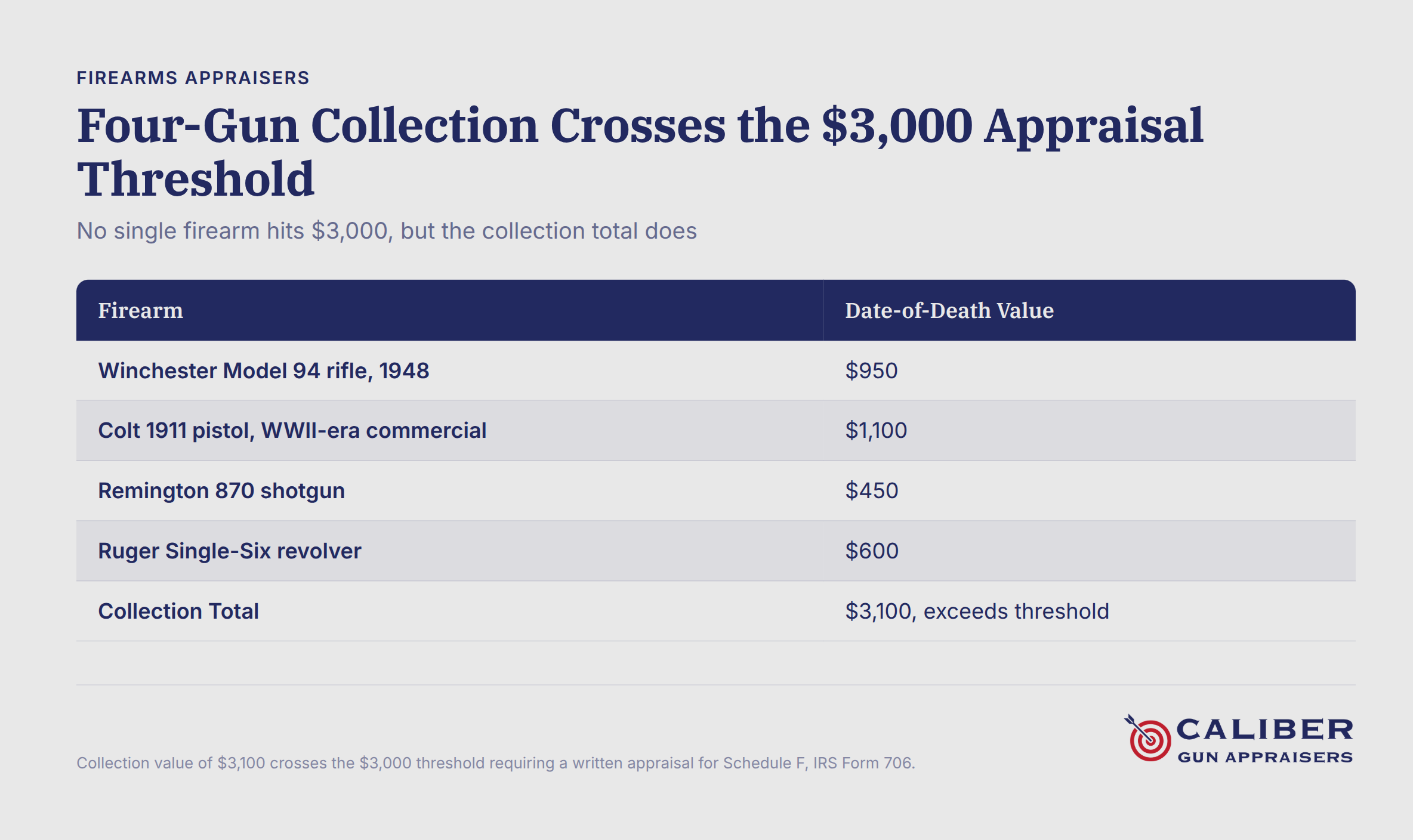
Here's how this plays out in practice. Suppose an executor is settling an estate that includes four firearms, none of which looks especially valuable on its own.
| Firearm | Date-of-Death Value |
|---|---|
| Winchester Model 94 rifle, 1948 | $950 |
| Colt 1911 pistol, WWII-era commercial | $1,100 |
| Remington 870 shotgun | $450 |
| Ruger Single-Six revolver | $600 |
| Collection total | $3,100 |
No single firearm in that table reaches $3,000. But as a collection of similar items, the group totals $3,100, which crosses the threshold and calls for a written appraisal to support the value reported on Schedule F. This is exactly the scenario where an executor who values item-by-item can miss the requirement entirely, only to have the estate's reported value questioned later because no qualified appraisal was on file.
What a USPAP-Compliant Firearms Appraisal Must Include
A firearms appraisal prepared for Form 706 needs to do more than list a dollar figure next to each gun. Regulations governing estate tax appraisals call for a level of documentation that most collectors, and most general estate liquidators, don't produce on their own.
A report prepared to meet these requirements typically includes:
- Itemized description of each firearm, including make, model, caliber, serial number, year of manufacture, and condition
- Comparable sales data drawn from the relevant collector or firearms market, not general retail pricing
- A qualified appraiser statement, identifying the appraiser's credentials, methodology, and confirming no conflict of interest in the outcome
- The effective date of value, matching the date of death or the alternate valuation date if elected
- Photographs documenting condition and any features affecting value, such as engraving, factory letters, or historical provenance
Our appraisers hold credentials with organizations such as the ASA, ISA, and AAA, and every firearms report is prepared in accordance with USPAP (the Uniform Standards of Professional Appraisal Practice). That standard is what gives an executor's CPA, the estate's attorney, and the IRS a consistent basis for evaluating the report, rather than a one-page opinion letter with no supporting analysis.
For larger or more complex collections, especially ones involving National Firearms Act items or pieces of genuine historical significance, our step-by-step approach to inventorying an inherited gun collection covers how to organize records before an appraiser ever arrives.
Pro tip: Photograph every firearm and record serial numbers before the estate distributes any items to heirs. Once pieces are split among family members, reconstructing an accurate collection-wide inventory becomes far harder, and gaps in documentation weaken the appraisal's credibility.
The Alternate Valuation Date Election Under IRC Section 2032
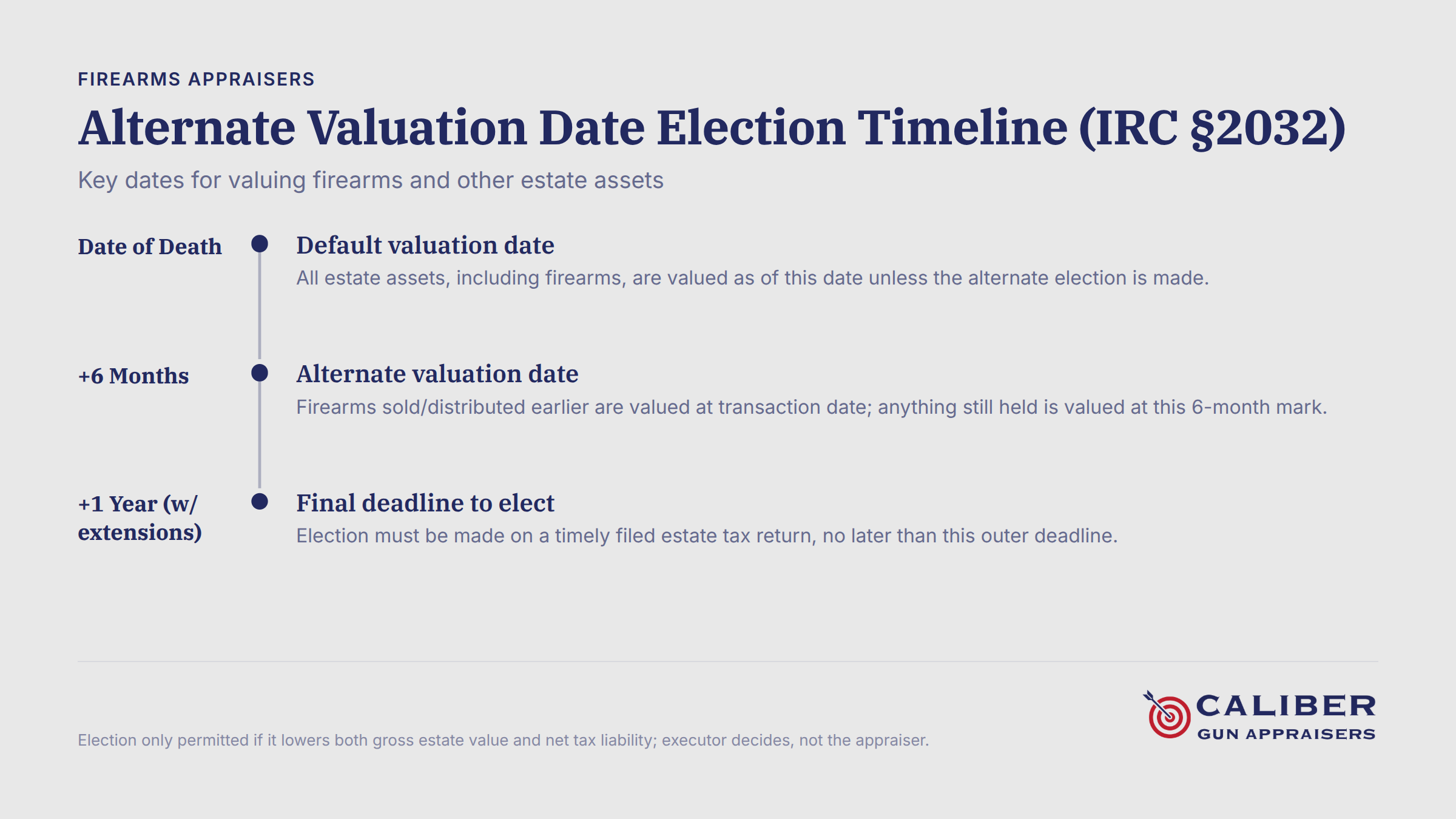
Federal tax law allows an estate to elect an alternate valuation date, six months after the date of death, instead of valuing everything as of the date of death itself. The election is only available if it decreases both the value of the gross estate and the estate's net tax liability; it cannot be used to increase reported values, and the executor, not the appraiser, is the one who decides whether to make it.
The mechanics matter for firearms specifically. If a gun collection is sold or otherwise distributed within six months of death, each firearm sold or distributed during that window is valued as of the date of that transaction. Anything still held by the estate at the six-month mark is valued as of that later date instead. The election itself must be made on a timely filed estate tax return, and it can be made no later than one year after the return's normal due date, including any extensions granted.
This is where a firearms appraisal earns its keep twice. If gun values are rising, sticking with the date-of-death figure may lower the taxable estate. If values have dropped, an appraiser can document the six-month figure instead, and the estate benefits from the lower number. Either way, the executor needs a defensible, dated valuation to support whichever figure the return actually claims.
Stepped-Up Basis: Why the Appraisal Matters to Heirs, Not Just the IRS
The value reported on Form 706 doesn't just determine the estate's tax bill. It also sets the heirs' basis in the firearms going forward, a concept commonly called the stepped-up basis. When an heir eventually sells an inherited gun, capital gains tax is calculated against the value reported at the time of inheritance, not against whatever the decedent originally paid.
Example: Suppose a decedent bought a rifle in 1975 for $300. If it's appraised and reported on Form 706 at $2,800, and an heir later sells it for $3,000, the heir owes capital gains tax on only $200 of appreciation, not on $2,700. Without a documented appraisal, the heir has no clear basis to point to and may end up paying tax on far more gain than actually occurred.
This is one reason estates sometimes file Form 706 even when the gross estate falls below the filing threshold: establishing a documented, defensible basis for valuable property protects heirs from an inflated tax bill years down the road. A written firearms appraisal is what makes that stepped-up basis stand up if it's ever questioned.
What This Costs and What to Expect
A standard firearms appraisal for estate tax purposes is quoted as a fixed fee before work begins, based on the number of firearms, the completeness of existing records, and whether the report needs to meet IRS-qualified appraisal standards. Standard reports start from $195, and IRS-qualified reports built specifically for estate and gift tax filings start from $295. Typical engagements for a household-size collection run from $195 to $995, while large or historically significant collections with extensive research requirements can run from $1,600 to $3,500 or more.
Fees are driven by the scope of the work, not by how valuable the guns turn out to be. A collection with clean records and a handful of common firearms costs less to appraise than one with incomplete documentation, disputed provenance, or dozens of pieces requiring individual research, regardless of what either collection is ultimately worth.
Executors managing a firearms collection alongside other estate property don't need to guess at valuation or hope a general appraiser understands the collector market. Request an appraisal and our team will scope the engagement, confirm which items cross the $3,000 threshold, and deliver a report built to support the figures on Schedule F.
This article is provided for general informational purposes only and does not constitute legal, tax, or financial advice. Readers should consult a qualified attorney or CPA regarding their specific circumstances.