
Blog
How to Inventory and Appraise an Inherited Gun Collection Step by Step
Appraising an inherited gun collection means separating NFA-regulated firearms from ordinary ones, building a serialized inventory, and getting a USPAP-compliant fair market value appraisal before any distribution or sale. This guide walks executors and heirs through each step, including which ATF forms apply and what a qualified appraiser documents for every firearm.
Inheriting a relative's gun collection usually means becoming, almost overnight, the person responsible for a pile of federally regulated property that a probate court expects you to account for accurately. Get the inventory wrong, skip a required ATF form, or hand a firearm to a beneficiary before the estate closes, and you can create real legal exposure and family conflict. This guide walks executors and heirs through securing the firearms, building a defensible inventory, identifying which items fall under the National Firearms Act, and getting the appraisal a probate court, the IRS, or skeptical co-heirs will actually accept.
If you're already the named executor, our gun appraisal for probate service is built for exactly this situation: a written, USPAP-compliant valuation you can hand to the court and to every heir at once.
Step 1: Secure and Store the Firearms Safely First
Before any inventory work begins, move every firearm to a single, locked location that only the executor or another legally eligible adult can access. Do not let individual heirs "hold onto" pieces of the collection informally, even temporarily. Once items scatter, tracking serial numbers and condition becomes far harder, and disputes over who has what tend to follow.
Check early whether the executor is legally eligible to possess firearms under state law; some states also require a licensed dealer or third party to hold the collection if the executor cannot lawfully possess firearms themselves, per general guidance on transferring gun ownership after death. If in doubt, a local federal firearms licensee (FFL) can store the collection under bond while the estate is settled.
Pro tip: Photograph every firearm's serial number, action, and any markings before you move anything. It costs you ten minutes and saves an argument later about which gun is which.
Step 2: Build an Item-by-Item Inventory
An inherited collection should never be inventoried as a lump sum. For each firearm, record the following details in a single spreadsheet or log:
- Manufacturer, model, and caliber or gauge
- Serial number and year of manufacture, if stamped or determinable
- Action type and configuration (bolt, lever, semi-automatic, barrel length)
- Condition, including finish wear, mechanical function, and any modifications
- Accessories, original box, factory papers, and any known chain of ownership
This same inventory does double duty. If the estate is large enough to require federal estate tax reporting, the identical serialized list feeds directly into that filing, and our gun appraisal for estate tax service uses the same item-level format the IRS expects to see.
Key takeaway: A group of firearms can be worth more, or less, than the sum of its individual pieces. A matched pair of engraved shotguns, a documented set from a single maker, or a complete run of a collectible model can carry a premium as a set that disappears if the guns are split up and sold separately. Conversely, a mixed box of unremarkable hunting rifles rarely gains anything from being grouped. A qualified appraiser evaluates the collection both ways and reports whichever value is actually supportable.
Step 3: Identify NFA-Regulated Firearms Before Any Sale or Distribution
Set aside any suppressors, short-barreled rifles or shotguns, machine guns, destructive devices, or "any other weapons" (AOWs) as soon as you spot them. These items are regulated under the National Firearms Act, and they cannot be handled, sold, or distributed the same way as an ordinary rifle or handgun.
During probate, an executor, administrator, or personal representative may hold an NFA firearm that was registered to the decedent without that possession counting as a "transfer" under federal law, according to ATF guidance on transfers of NFA firearms in decedents' estates. That breathing room exists specifically so an estate can be settled properly instead of rushing a transfer.
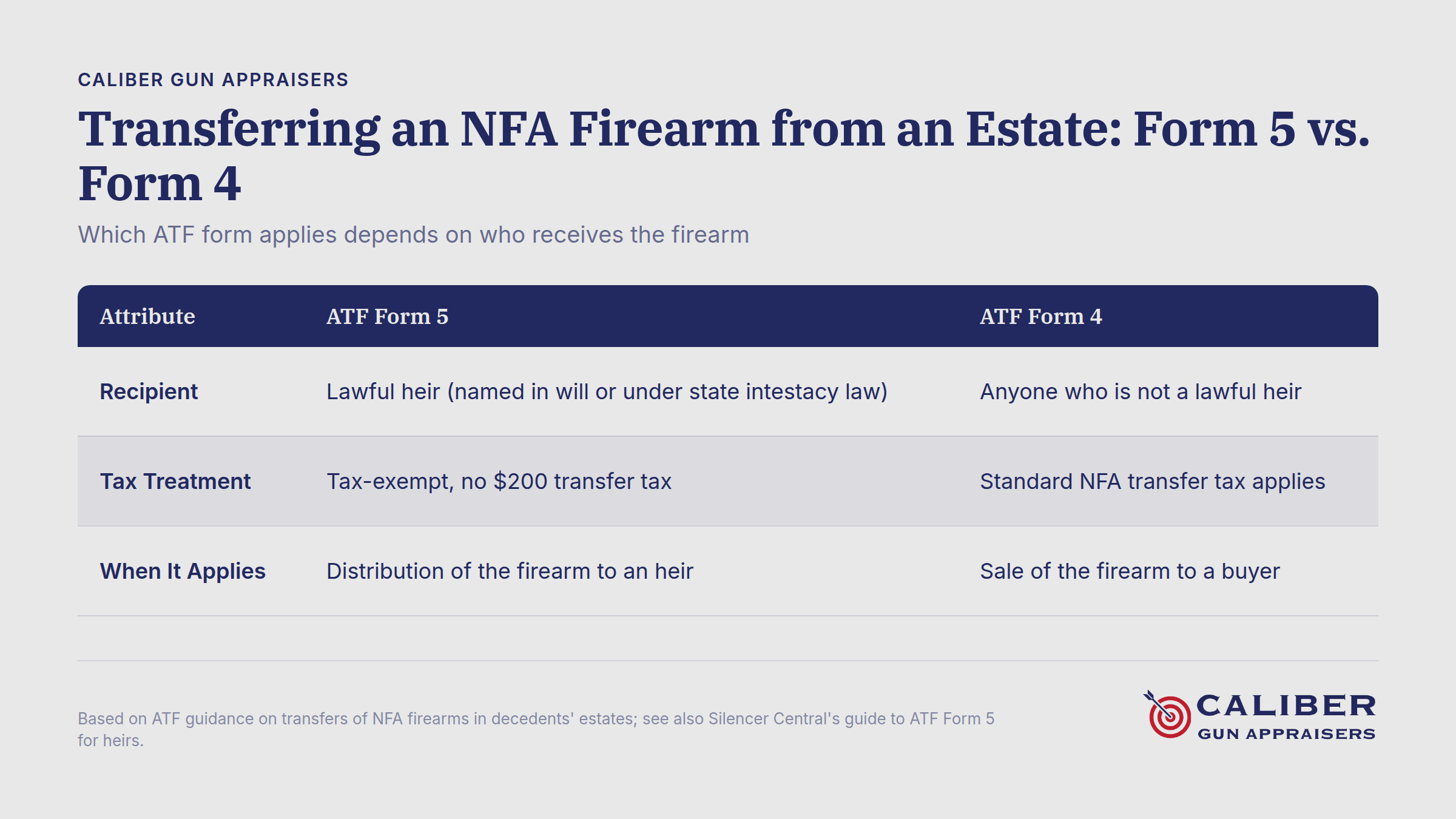
When it comes time to actually move an NFA firearm out of the estate, the form depends on who is receiving it:
- Distribution to a lawful heir (someone named in the will, or an heir under state intestacy law if there is no will) uses ATF Form 5, a tax-exempt transfer with no $200 transfer tax.
- Sale to anyone who is not a lawful heir requires an ATF Form 4 transfer and payment of the standard transfer tax, the same as any other NFA sale.
A practical breakdown of the Form 5 process for heirs is available from firearms retailers who handle these transfers routinely, including Silencer Central's guide to ATF Form 5 for heirs.
Watch out: An NFA firearm that was never properly registered to the decedent is legal contraband. It cannot be registered to the estate, appraised at a positive value, or distributed to anyone. If you find an unregistered suppressor or short-barreled item, contact the ATF's NFA Branch before doing anything else with it.
How Do You Get a Defensible Fair Market Value Appraisal Before Distributing the Guns?
The short answer: hire a qualified firearms appraiser to inspect and value every item before a single gun leaves the estate, and get the result in writing. A probate court generally requires a documented inventory and value for tangible personal property, and a written appraisal is the cleanest way to satisfy that requirement while protecting the executor personally.
Heirs disagree about value more often than they disagree about anything else in an estate. If one heir takes a rifle worth $3,000 while another gets one worth $300, and there's no independent documentation behind either number, that's a lawsuit waiting to happen. A signed appraisal report, prepared before distribution, removes the guesswork and gives every party the same starting point.
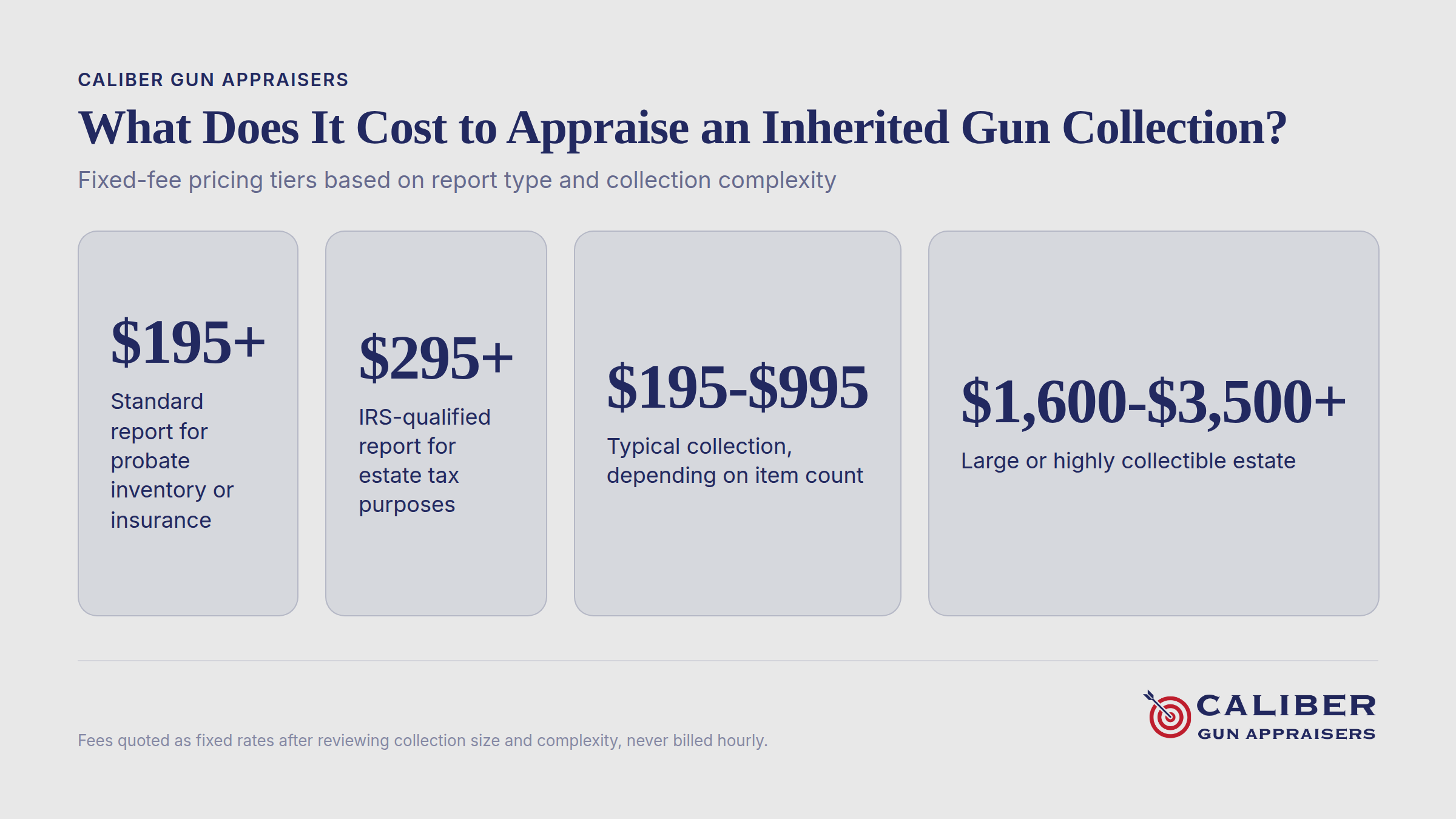
Engagements like this are quoted as a fixed fee after the appraiser reviews the size and complexity of the collection, never billed hourly. For firearms specifically, fees are typically quoted based on the number of items, documentation available, and whether the report needs to meet IRS-qualified standards for estate tax purposes versus a standard report for probate inventory or insurance. Straightforward standard reports start around $195, IRS-qualified reports start around $295, and a typical collection runs $195 to $995 depending on item count and research required; a large or highly collectible estate can run $1,600 to $3,500 or more.
What Does a Qualified Firearms Appraiser Document for Each Item?
A proper appraisal report goes well beyond "looks like a nice rifle, worth about $500." For each firearm, an appraiser working to industry standards documents:
- Identification: manufacturer, model, serial number, caliber, and configuration, matched against manufacturing records where possible
- Condition grading: finish, bore condition, mechanical function, and any repairs or modifications, using consistent industry grading terminology
- Collector or historical significance: whether the piece is tied to a notable maker, a limited production run, a documented prior owner, or a specific historical period
- Comparable sales: recent auction results, dealer listings, and private-sale data for the same or closely comparable models, adjusted for condition and configuration
This is the same underlying approach used across personal property appraisal generally: individual items get identified and valued on their own merits, then the appraiser considers whether the group as a whole (the collection effect described above) changes the picture. Firearms appraisers commonly hold credentials through organizations such as the International Society of Appraisers, the American Society of Appraisers, the Appraisers Association of America, or CAGA, and prepare reports in accordance with the Uniform Standards of Professional Appraisal Practice published by The Appraisal Foundation.
A firm law-firm-oriented overview of how firearms fit into broader estate administration is available from Sage Trust Law's guidance on firearms and estate planning, and executors handling the probate side more generally can find useful background in the Wisconsin Bar's discussion of estate administration issues.
Distribution to Heirs vs. Consignment or Sale
Once the appraisal is complete and the estate's plan for the firearms is settled (either through the will or through agreement among heirs under intestacy), there are really only two paths for each item:
- Distribute the firearm to a lawful heir. Ordinary Title I firearms transfer according to state law and the will; NFA items transfer tax-exempt using ATF Form 5, as covered above.
- Sell or consign the firearm to someone outside the family. Title I firearms move through a licensed dealer per state and federal transfer rules; NFA items require an ATF Form 4 transfer and payment of the transfer tax, since the buyer is not a lawful heir.
Either way, the appraised value from Step 4 is what the estate uses to record the disposition, whether that's an equal-value split among heirs, a buyout where one heir pays the estate for a firearm they want to keep, or proceeds from a sale that get divided per the will.
Getting the Collection Appraised Correctly the First Time
An inherited gun collection sits at the intersection of probate law, federal firearms regulation, and personal property valuation, and skipping any one of those pieces creates problems that are much harder to fix after the fact than to prevent up front. Secure the firearms, build a serialized inventory, separate out anything NFA-regulated, and get a written fair market value appraisal before a single item changes hands. From there, distribution or sale is a straightforward paperwork exercise instead of a family dispute.
Our appraisers prepare USPAP-compliant firearm valuations built specifically for probate, insurance, and estate tax purposes. If you're managing an inherited collection right now, contact our team to scope the appraisal and get a fixed-fee quote before you move forward.
This article is provided for general informational purposes only and does not constitute legal, tax, or financial advice. Executors and heirs should consult a qualified attorney or CPA, and coordinate directly with the ATF where NFA-regulated firearms are involved, regarding their specific circumstances.